
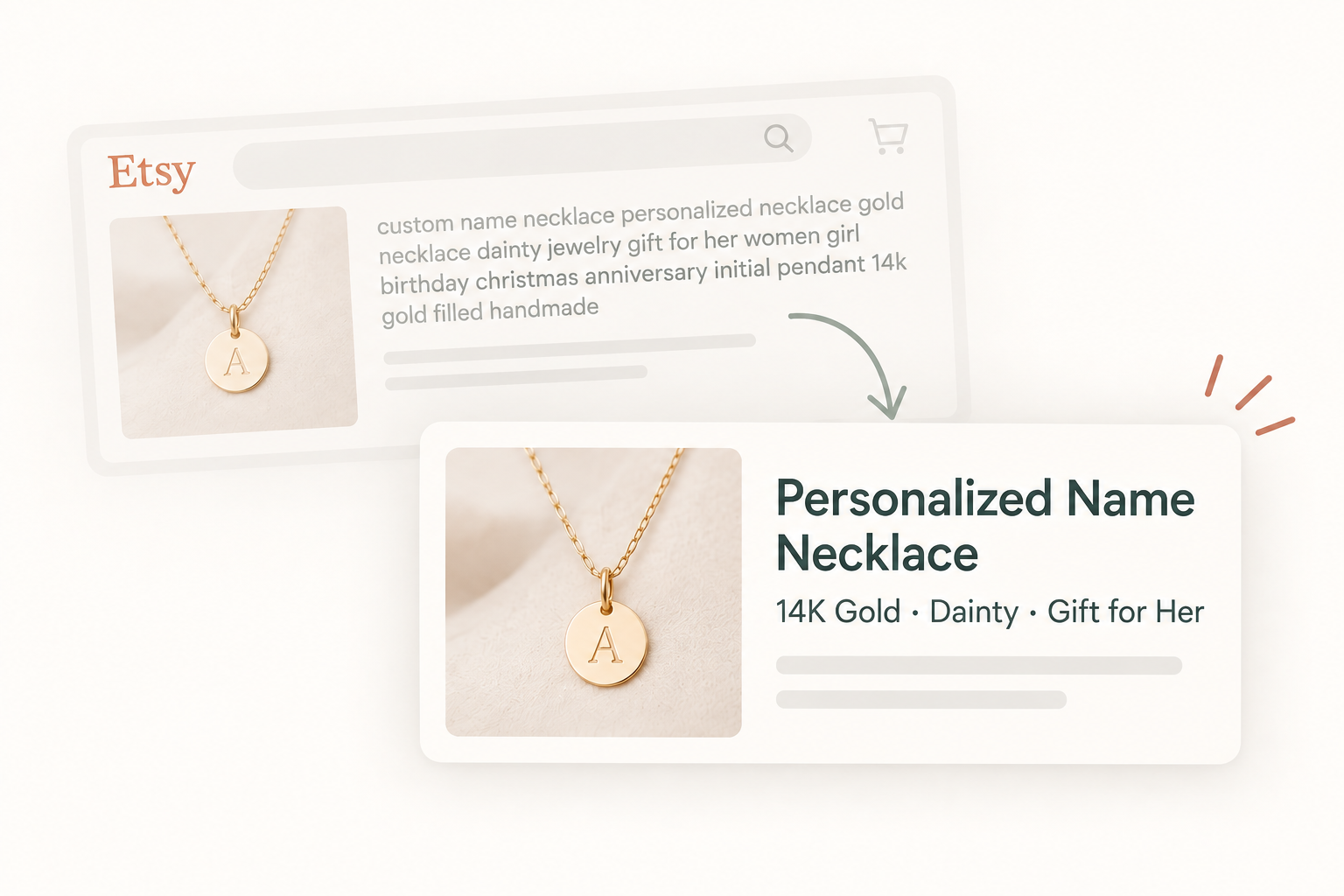
A good Etsy title in 2026 works like a product label, not a slogan. It names the item once, adds the facts a shopper needs to recognize it — color, material, size, the specs that actually define it — and only includes a recipient or occasion when that meaningfully describes the product, or is a strong way shoppers search for it. Stay inside 140 characters. Aim for under 15 words. And make sure it still reads as a complete product if a phone cuts it off around 50–60 characters.
Lead with what it is. That's for people scanning on their phones, and for Google snippets — not because the first words get extra ranking weight. Word order doesn't change how Etsy scores position in the title. Repeating the same keyword doesn't help. Titles still matter; they're one of the fields Etsy uses to match a listing to a search. They're not the whole system. Tags, attributes, and the description do different jobs. For the wider map, read The Complete Etsy SEO Guide. This page is just the title.
What You'll Learn
- What makes a strong Etsy title now, including the 140-character limit and the “consider under 15 words” guidance
- Where the primary keyword belongs, and why position doesn't change Etsy ranking
- When color, size, material, occasion, and recipient belong in the title — and when they belong somewhere else
- The Name-Facts-Fit formula, ten before-and-after titles, and a rewrite process you can run on any listing
- How title, tags, attributes, and description split the work so you stop stuffing one field
What Makes a Good Etsy Title in 2026
A good title lets a stranger picture the product in one glance. Specific. Scannable. Honest. Not a pile of synonyms, a sale announcement, or a mood board.
Etsy still caps titles at 140 characters and asks you to consider keeping them under 15 words. That's a scan standard — fewer words, a clearer noun, the facts a shopper would use to decide “this is the thing.” It isn't a request to strip out useful detail.
If only the first line showed on a lock screen, would it still say what you sell?
Run these tests:
- What is it? One clear item noun. Necklace, not “beautiful unique jewelry gift.”
- Which one is it? Color, material, size, and the specs that separate this listing from the next one in search.
- Does Fit belong? Recipient or occasion belongs when it meaningfully describes the product — a dad shirt, a bridal comb, a name necklace — or when it's a strong, specific way shoppers search for this item. Don't add generic phrases like “gift for her” just to fill title space.
- Would you put this on a physical label? If it sounds like a slogan, it belongs in the description.
That last test is the whole job. Think of the title as the shop window: it has to name what's for sale clearly enough that someone stops. Tags, attributes, and description hold the rest.
This is also questions 1 and 2 of the Six Buyer Questions from How to Write Product Listings That Actually Sell: What is it? Is it for me? The title should answer those two. It shouldn't try to answer all six.
Sage Tip: Delete every compliment word — beautiful, unique, stunning, perfect gift. If a real product is still sitting there, you were already close. If nothing's left, you never named the item.
Titles Still Matter — They Just Don’t Do All the Work
Yes, titles still matter for search. Etsy uses the title as one matching field, along with tags, attributes, category, and other listing content. A vague title makes matching harder. A stuffed title makes scanning harder. Neither is a ranking cheat code.
Search can match a listing from more than one field, which is why a clean title plus accurate tags and attributes beats a packed 140-character title with empty attributes.
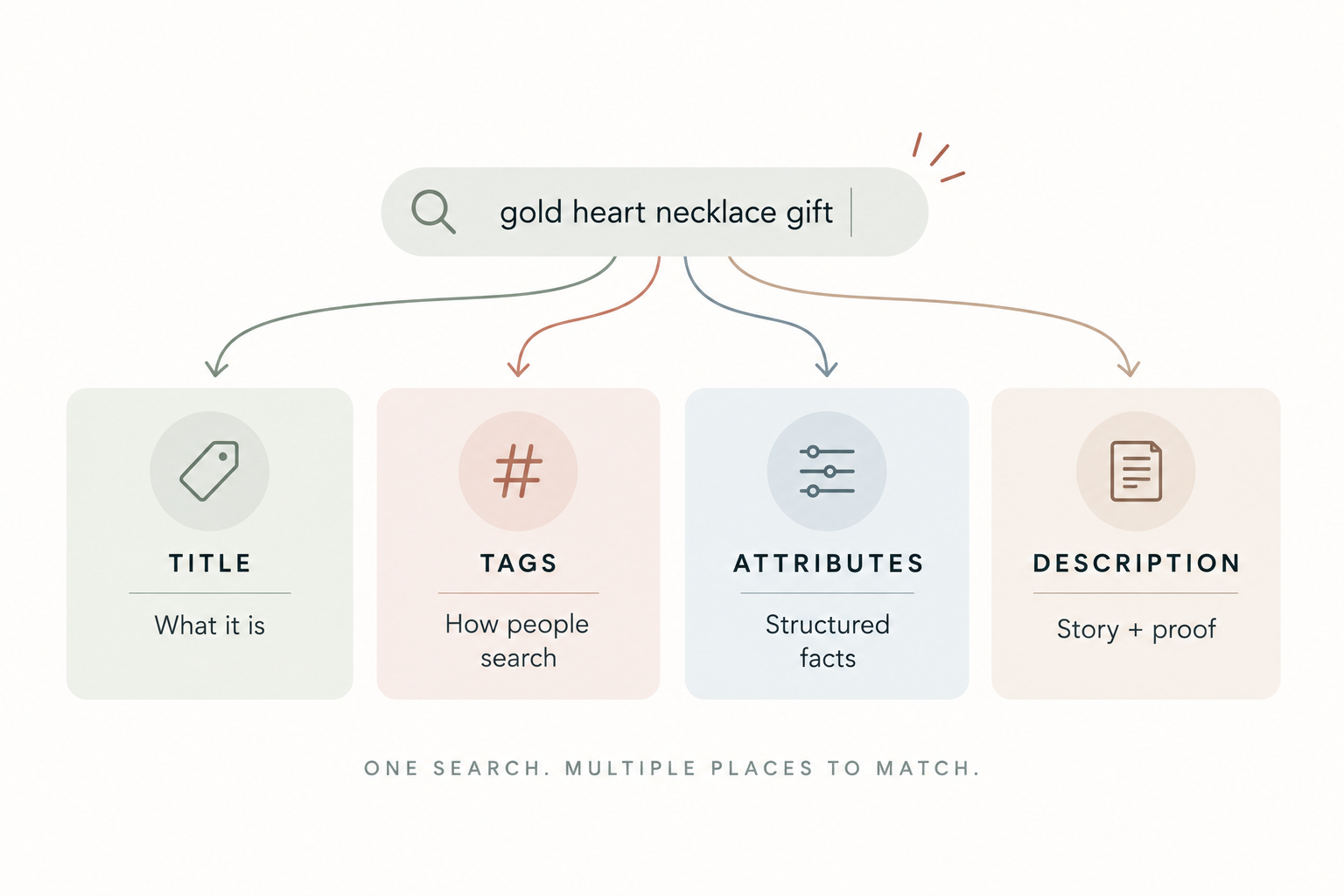
Titles also work outside Etsy's own results. Google often shows roughly the first 50–60 characters. Mobile listing cards truncate. A title that only makes sense at character 90 never gets read. Mattering is not the same as doing all the work.
If you're tempted to turn this into a full ranking tutorial — traffic sources, attributes deep-dives, query research — stop and open The Complete Etsy SEO Guide. Stay here for titles.
Buyer Question: “What is it, and is it for me?” Your title can answer those two. Trust, price, and what happens next belong in photos, description, and policies — not in a longer title.
The Name-Facts-Fit Formula
You only need one formula.
[DIAGRAM: A product-label stack in three bands. Top band Name: the item noun once (What is it?). Middle band Facts: color, material, size, defining specs. Bottom band Fit: recipient, occasion, or style when it meaningfully describes the product or is a strong search phrase (Is it for me?). A side note reads: Cover Fit — if a real product remains, ask whether Fit is earning its space.]
- Name: The item noun, once. Cutting board, moonstone pendant, soy candle, linen table runner. This is “What is it?”
- Facts: Color, material, size, and the specs that define the SKU. Walnut, 12x18, 14k gold filled, 8 oz, sage green linen. These are the words shoppers use when they already know the category and are picking a version.
- Fit: Recipient, occasion, or style when it meaningfully describes the product or reflects a strong way shoppers search for it. Personalized with a family name. Dad t-shirt. Bridal hair comb. This is “Is it for me?” — keep it when “for me” is built into the product, or is a real search phrase for this listing. Don't use it as filler.
The cover test: Put your thumb over the Fit words. If the title still names a real product, Fit may be extra — move generic gift language to tags. If the title becomes a generic object that is no longer this listing — a board with no personalization, a shirt with no dad joke, a comb with no bridal role — Fit belongs in the title.
Name-Facts-Fit is The Right Information in the Right Place, applied to one field. You're not storing every true fact about the shop in the title. You're putting the facts that identify the object.
A working pattern, not a mad-lib you have to copy:
[Fit only if it earns its space] [Fact] [Name] [Fact] [Fact]
In plain English: Personalized walnut cutting board, 12x18. 14k gold filled moonstone pendant necklace, 18 inch. Sage green linen table runner, 72 inch.
What it refuses: repeating the noun, stacking synonyms, adding shipping or sale language, and treating “gift for her” as automatic title copy.
Writing a new listing? ListSage can turn your product photos into a first draft of your Etsy title, tags, description, and other listing fields. Use the Name-Facts-Fit test above to review the title before publishing.
How Long Should an Etsy Title Be?
The hard limit is 140 characters. Etsy also asks you to consider keeping titles under 15 words. Don't treat 140 as a fill line. Don't treat 15 words as a law that bans a needed size or metal.
Three lengths get mixed up. Keep them apart:
- Listing title: 140-character maximum; consider under 15 words so it scans.
Shop tagline: 55 characters — a different field, not your listing title.
Google snippet: Often about 50–60 characters of the title before truncation.
You can confirm the listing title cap in Etsy's how to create a listing help article. The under-15-words steer is current title guidance: write a label people can finish in one look. That's in Etsy's seller handbook notes on titles.
Practical length rules:
- Stop when Name, needed Facts, and useful Fit are in. Leftover characters aren't a problem.
- Read the first 50–60 characters out loud. If they already name a complete product, mobile and Google won't mangle you.
- Count words after you draft, not before. A 12-word title with a real noun beats an 8-word title made of fluff.
- If you're over 15 words, cut synonyms and slogans first, then generic gift language, then the least identifying fact — not the noun.
Short is not the same as empty. “Candle” is short and useless. “Lavender soy candle 8 oz amber jar” is short and complete.
[DIAGRAM: Truncation strip. One title shown three ways: a cream bar marked at ~50–60 characters (Google snippet), the full readable label under 15 words, and a faint 140-character ceiling. Caption: 55 characters is the shop tagline, not this field.]
Word Order, Repeats, and Title Myths
Word order doesn't change Etsy ranking by position. Put the primary keyword first because shoppers, lock screens, and Google snippets read left to right — not because the first slot is worth more to Etsy's ranker.
Where a phrase is used in your title doesn’t affect ranking.
That's from Etsy's Keywords 101 handbook, and it's the line that kills the old “front-load for the algorithm” habit.
Exact wording can still matter for relevancy: if someone searches a phrase, and your listing uses that phrase, matching is easier than if you never used it. That's matching, not a secret weight for word number three. Etsy's how search works overview is the place to go if you want the matching-then-ranking picture — not more title math.
Don't repeat keywords in the title. Once you've named the item, say something else true. “Leather tote leather bag leather purse” is three ways to waste space.
Myths to drop:
- Myth: The first 40 characters get extra rank.
Reality: Early characters get extra reading. Rank position in the title is not a scoring bonus. - Myth: You should hit 140 characters every time.
Reality: 140 is a ceiling. Filling it is not a goal. - Myth: Pipe characters let you pack more keywords.
Reality: Pipes are hard to scan, eat characters, and often hide the noun behind a wall of fragments. - Myth: Subjective words help you stand out in search.
Reality: Beautiful, unique, stunning, and “perfect gift” don't identify the SKU. Put them in the description if you must; don't spend a tag on “beautiful.” - Myth: Occasion and recipient always belong up front.
Reality: Color, material, and size usually do. Include occasion or recipient when they meaningfully describe the product or reflect a strong way shoppers search for it — not as generic filler like “gift for her.” - Myth: Titles no longer matter because search is “holistic.”
Reality: Holistic means more fields share the work. It doesn't mean the title can be blank or stuffed. - Myth: Never overlap a title word with a tag.
Reality: Overlap is fine. Don't clone an exact category or attribute as a standalone tag.
Word order does matter for click-through. “18 inch 14k gold filled moonstone pendant necklace” is accurate and clumsy. “14k gold filled moonstone pendant necklace 18 inch” leads with the thing. Same words. Easier to scan.
Common Mistake: Stuffing every tag into the title. Tags exist so the title doesn't have to hold every search phrase.
Title vs. Tags vs. Attributes vs. Description
Four fields. Four jobs. Overlap is allowed. Cloning is not.
- Title: Name + Facts + Fit that earns its space. Written for humans who are skimming a grid.
Best for: The item noun, color, material, size, the one personalization that defines the SKU. - Tags: 13 tags, 20 characters each. Search phrases people type, including gift language that didn't earn a place in the title.
Best for: Alternate names, use cases, “gift for her,” style words that are not the product.
Do not: Clone the exact category or attribute as a standalone tag, or waste a tag on “beautiful.” - Attributes: Structured facts Etsy can filter. Color, size, occasion, recipient, material when the form offers them.
Best for: Filterable truth. Use occasion attributes only if the item is made for that occasion.
Do not: Skip attributes because the title already mentioned navy. - Description: Natural language. How it feels, how to use it, what's included, the rest of the Six Buyer Questions.
Best for: Subjective language, care, shipping context that isn't a title keyword, proof.
Do not: Repeat the title three times and call it a description.
Etsy explains tag mechanics in how to use tags to get found in search. The useful idea for titles: tags can carry phrases you correctly left out of the title. Overlap between title words and tags is fine. An identical copy of your category path as a tag isn't doing extra work.
One SKU, four fields — lavender soy candle, 8 oz, amber jar:
- Title: Lavender Soy Candle 8 oz Amber Jar Cotton Wick
Sample tags: lavender soy candle, 8 oz soy candle, amber jar candle, cotton wick candle, bedroom candle, relaxation candle, handmade soy candle, gift for her (generic gift language lives here unless it actually describes this candle)
Attributes: Scent lavender; size 8 oz; material soy wax; color amber — plus occasion only if you truly made a wedding candle, not a lavender candle you hope is gifted
First description sentence: This 8 oz lavender soy candle is poured into an amber jar with a cotton wick for a steady, quiet burn on a nightstand or bath shelf.
Same product. Four jobs. The title never had to say “luxury gift for her birthday.”
Sage Tip: If a word is already a clean attribute, you don't need to invent a clever title synonym for it. Say it once in the title if it identifies the SKU, set the attribute, and move on.
Etsy Title Examples: Before and After
Each after-title follows Name-Facts-Fit. Steal the why, not just the wording.
1. Personalized gift — Fit is the product
- Before: Beautiful Custom Cutting Board Gift for Her Wedding Anniversary Personalized Kitchen Decor Unique Gift
After: Personalized Walnut Cutting Board Engraved with Family Name 12x18
Why: The board is a named, engraved object. Family name is Fit you can't cover up without losing the SKU.
2. Jewelry — stone and metal, not adjectives
- Before: Beautiful Unique Handmade Necklace Gift for Women Boho Jewelry
After: 14k Gold Filled Moonstone Pendant Necklace 18 Inch
Why: Stone and metal identify the piece. Beautiful and unique identify nothing.
3. Apparel — it is a dad shirt
- Before: Funny Dad Shirt Gift for Him Fast Shipping Sale Father's Day Tshirt
After: Funny Dad T-Shirt World's Best Grill Master Cotton Unisex
Why: Recipient stays because the shirt is a dad shirt. Sale and shipping are not the product.
4. Print-on-demand custom sweatshirt
- Before: Custom Sweatshirt Personalized Gift for Her Aesthetic Trendy Hoodie
After: Custom Name Sweatshirt Embroidered Crewneck Unisex S-3XL
Why: Custom name is what you make. Aesthetic and trendy are tags, if they're even worth a tag.
5. Home decor — color, material, size
- Before: Farmhouse Table Decor Beautiful Linen Runner Gift for Home
After: Sage Green Linen Table Runner 72 Inch Hemstitch
Why: A shopper comparing runners needs color, cloth, and length, not a lifestyle adjective.
6. Candle — scent and size; “gift for her” is usually a tag
- Before: Luxury Candle Gift for Her Birthday Gift Relaxing Home Fragrance
After: Lavender Soy Candle 8 oz Amber Jar Cotton Wick
Why: Cover “gift for her” and you still have a candle. That phrase didn't describe the product, so it didn't earn title space.
7. Art print — the noun is print
- Before: Unique Wall Art Beautiful Floral Painting Digital Download Gift
After: Watercolor Wildflower Print 11x14 Unframed Botanical Art
Why: Print is the item. Size is a fact. Unique wall art could be anything on the wall.
8. Accessory — occasion when it is for that occasion
- Before: Sparkly Hair Clip Beautiful Accessory Gift for Her Wedding Guest
After: Ivory Pearl Bridal Hair Comb Gold Plated Wedding Accessory
Why: This comb is made for a wedding, so occasion belongs. An everyday leather tote wouldn't need Christmas or mom in the title.
9. Pipe-separated stuffing → a scannable label
- Before: Gold Hoop Earrings | 14k Gold Filled | Hypoallergenic | Lightweight | Gift for Her | Minimalist Jewelry | Everyday Hoops | 30mm
After: 14k Gold Filled Hoop Earrings 30mm Lightweight Hypoallergenic
Why: Same facts, no pipes, no generic gift phrase. It's readable in a search grid.
10. Truncation demo — complete in the first 50–60 characters
- Before: Handmade Ceramic Mug Coffee Lover Gift Unique Pottery Kitchen Decor Blue Speckle
After: Speckled Blue Ceramic Coffee Mug 12 oz Handmade
Why: The after-title is already a full product by the time a snippet or phone cuts it. The before-title is still saying “handmade ceramic mug coffee lover g…” — a vibe, not a SKU.
If you only steal one pattern: name the object, add the facts that pick this object, then keep Fit only when it earns its space.
How to Write or Rewrite an Etsy Title Step by Step
Do this on a new listing, or an old one that looks like example 9.
- Write the noun first. One item. If you sell a set, the noun is the set (pair of hoop earrings, not earring earring).
- List Facts on paper. Color, material, size, scent, metal, dimensions, personalization type. Circle only the facts that distinguish this listing from your other listings in the same category.
- Ask whether Fit earns its space. Does recipient or occasion describe the product, or is it a hoped-for use? Keep dad, bridal, engraved family name. Move generic “gift for her,” birthday, or Christmas (on a non-holiday item) to tags unless shoppers strongly search that way for this exact product.
- Draft Name-Facts-Fit in plain English. No pipes. No all caps. No shipping. Lead with what it is so the first 50–60 characters still work.
- Cut repeats and slogans. One noun. Zero beautiful/unique/stunning unless you're writing the description later — and even then, be specific instead.
- Count characters and words. Stay at or under 140. Prefer under 15 words if the facts still fit. If you're over, cut in this order: compliments, extra Fit, least identifying fact.
- Read it as a stranger. Would you know what to expect in the photos? If you need the first description sentence to explain the title, the title isn't done.
- Park leftovers in the right field. Alternate phrases → tags (13 × 20). Filterable facts → attributes. Feeling, use, proof → description. Optional: an AI title tool can give you an English starting point. It's a draft, not a decision. Run the output through this same formula.
If your current title has more than one pipe, more than one synonym for the same noun, or a sale/shipping phrase, start at step 1. Don't “trim” a stuffed title. Relabel the product.
When the title is stable, the slow part is doing this across a whole shop. ListSage can draft a title and the rest of the listing from photos you upload. It doesn't rank the listing, send traffic, or promise sales. You still choose the noun, keep the facts, and run the cover test.
Etsy Title Checklist
Run this before you publish, or after you rewrite.
- One item noun, used once
- Primary keyword leads because a human should see what it is first — not because position ranks
- Color, material, and size included when they define the SKU
- Occasion or recipient included when they meaningfully describe the product or reflect a strong way shoppers search for it — not as generic filler
- Cover test passed: hiding Fit still leaves a real product, or Fit is truly part of what this listing is
- No keyword repeats, no pipes, no sale or shipping language
- No subjective filler (beautiful, unique, stunning, perfect gift)
- 140 characters or fewer; under 15 words unless removing a word would eliminate an important product detail
- First 50–60 characters still name a complete product
- Leftover phrases assigned to tags, attributes, or description — not crammed back in
- Tags do not clone the exact category/attribute as a standalone tag
- Occasion attributes used only if the item is made for that occasion
Etsy Title FAQ
What is the Etsy title character limit?
140 characters. That's a hard cap on the listing title, not a target. The 55-character limit is the shop tagline — a different field.
How long does Etsy recommend for a title?
Consider keeping titles under 15 words, inside the 140-character limit. Shorter is for scanning. It isn't an excuse to drop color, material, or size when those facts are the product.
Where should the primary keyword go?
Lead with what the item is so people, mobile cards, and Google snippets understand it immediately. Placement in the title doesn't affect Etsy ranking.
Should I repeat keywords in the title?
No. Name the item once. Use remaining words for facts (and Fit that earns its space). Repeats cost scan time and don't add a ranking bonus.
Does word order matter?
Not for ranking position. Yes for scan and click-through. Put the noun and identifying facts where a skimming shopper can finish the thought.
Should color, size, occasion, recipient, or material go in the title?
Color, material, and size: yes, when they define the SKU. Occasion and recipient: include them when they meaningfully describe the product or reflect a strong way shoppers search for it. Don't add generic phrases like “gift for her” simply to fill title space.
Are titles still important for Etsy search?
Yes. The title is one matching field. It isn't the only field. Tags, attributes, category, and description still carry matching work. A clear title helps people and matching; it doesn't replace the other fields.
Can I overlap title words with tags?
Yes. Overlap is normal. Don't clone your exact category or attribute as a standalone tag, and don't spend a tag on a compliment word.
Should I use an AI title generator?
Optional, as an English starting point. Whatever you get still has to pass Name-Facts-Fit, the 140-character cap, the cover test, and this checklist.
Put the Title to Work
Your title has one job: name the product so a stranger can see it. Name once. Add facts. Keep Fit when it earns its space. Stay inside 140 characters, aim under 15 words, and make the first 50–60 characters a complete label. Don't repeat keywords. Don't rearrange words hoping it will rank higher. Don't make the title do every other field's job.
When the title is honest, fill the rest — tags for extra phrases, attributes for filters, description for the rest of the story. That's The Right Information in the Right Place. For the rest of search, use The Complete Etsy SEO Guide. For the rest of the listing copy, use How to Write Product Listings That Actually Sell.
Marketplace title rules shouldn't take an evening of rereading help docs every time you list something new. Upload photos and let ListSage draft a title plus the other listing fields, then hold that draft to this checklist. No ranking, traffic, or sales promises — only a first pass you still edit like a merchant who knows the product.
.png)
Lindsey Records
Founder of ListSage and a content strategist with 15+ years of experience in SEO, ecommerce, and AI. After growing her own Etsy and Shopify stores, she built ListSage to eliminate the hours of research, prompting, and rewriting required to create high-performing product listings.
.png)
.png)