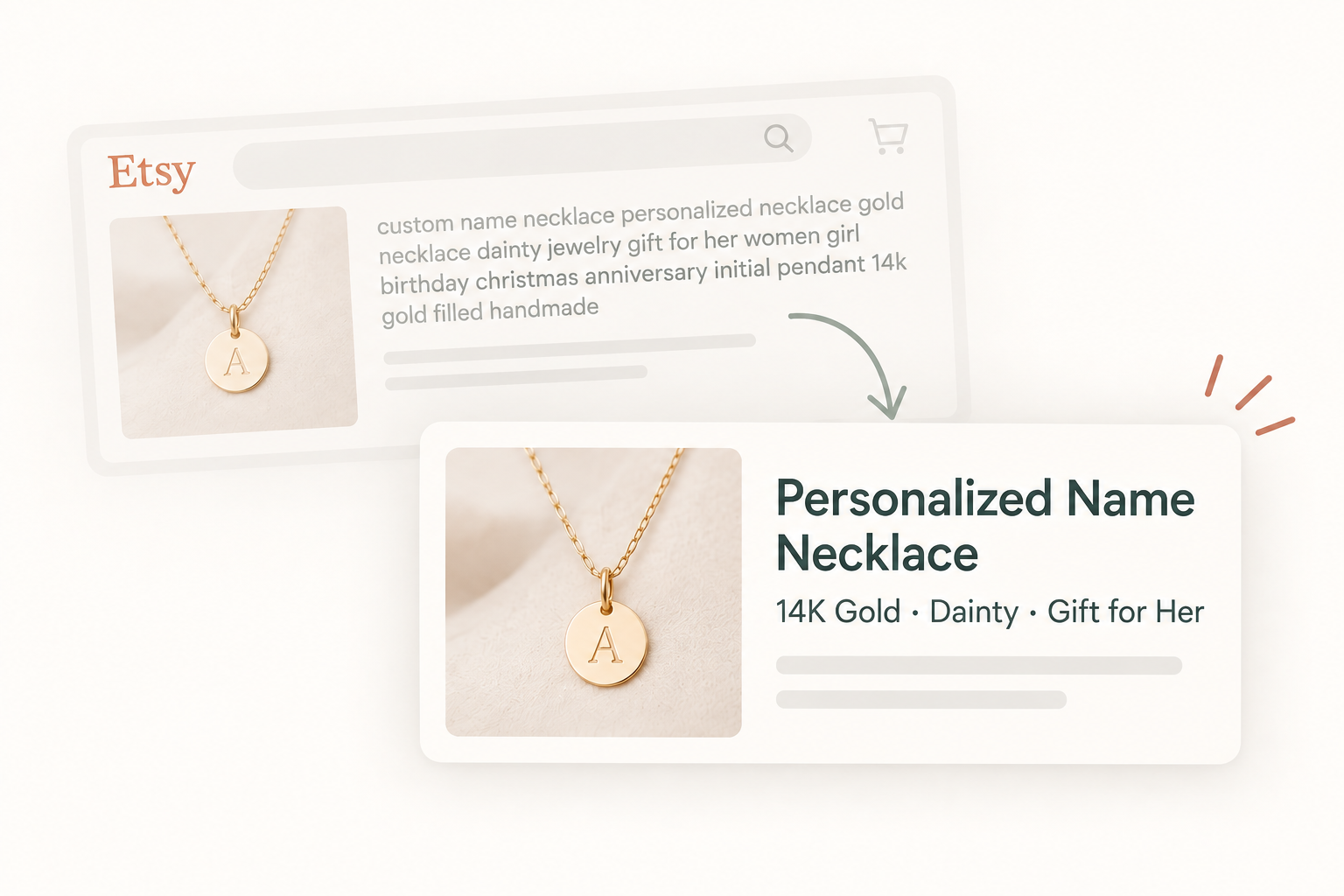
.png)
Introduction
Most sellers assume a listing fails because the product isn't good enough. Usually that isn't the problem. The more common mistake is assuming buyers think the way sellers do — that if the product is well-made, a buyer will naturally see its value the same way the seller does. Buyers don't have that context. They arrive at a listing as a stranger, with a specific problem to solve and a short list of questions that need answering before they'll click "buy."
Every part of a listing — the title, the description, the photos, even the bullet points — exists to answer one of those questions. When a listing fails, it's usually because it answered the wrong questions, answered them in the wrong order, or never answered them at all.
Every buyer is trying to answer the same six questions before they buy. We call this the Six Buyer Questions, and it's the thread running through every chapter in this guide:
The Six Buyer Questions
- What is it?
- Is it for me?
- Can I trust it?
- How will it fit into my life?
- Is it worth the price?
- What happens next?
A listing that answers all six, roughly in that order, removes the hesitation that keeps a browser from becoming a buyer. A listing that leaves any of them open invites the buyer to go find the answer somewhere else — usually a competitor's listing. This guide is about closing that gap: writing titles, descriptions, and photo sets that answer all six questions, on whichever marketplace you sell on.

What you'll learn:
- The Six Buyer Questions every buyer silently asks before they buy — the framework this whole guide is built around
- Why "SEO" and "conversion" are the same job, not two competing ones
- How to think about your buyer as someone gathering evidence, not someone being pitched to
- How to write titles and descriptions that lead with what matters
- What your photos need to do that your words can't
- How to use keywords without sounding like a robot
- The real differences between Etsy, Shopify, Amazon, and TikTok Shop — and where each platform's rules are published versus undisclosed
- How AI-powered shopping discovery changes (and doesn't change) what you should write
- A repeatable checklist you can use on every listing you write from here on
Chapter 1: Why Great Products Still Don't Sell
A lot of sellers treat "writing for search" and "writing for buyers" as two different jobs — one for an algorithm, one for a human. In practice, they're the same job, done well. Search systems on every major marketplace are built to reward listings that match what real shoppers are searching for, described in terms real shoppers use. A listing that clearly and specifically describes the product for a human being is, by design, the listing search systems are trying to find.
Think of it like a well-labeled aisle in a store. A good aisle sign doesn't need one label for the shopper and a separate, different label for the store's internal directory system. One clear, accurate label does both jobs at once. The mistake sellers make is decorating their listing for an imaginary "algorithm" instead of the person standing in the aisle — stacking in extra keywords, superlatives, and repetition that no shopper asked for and no platform rewards.
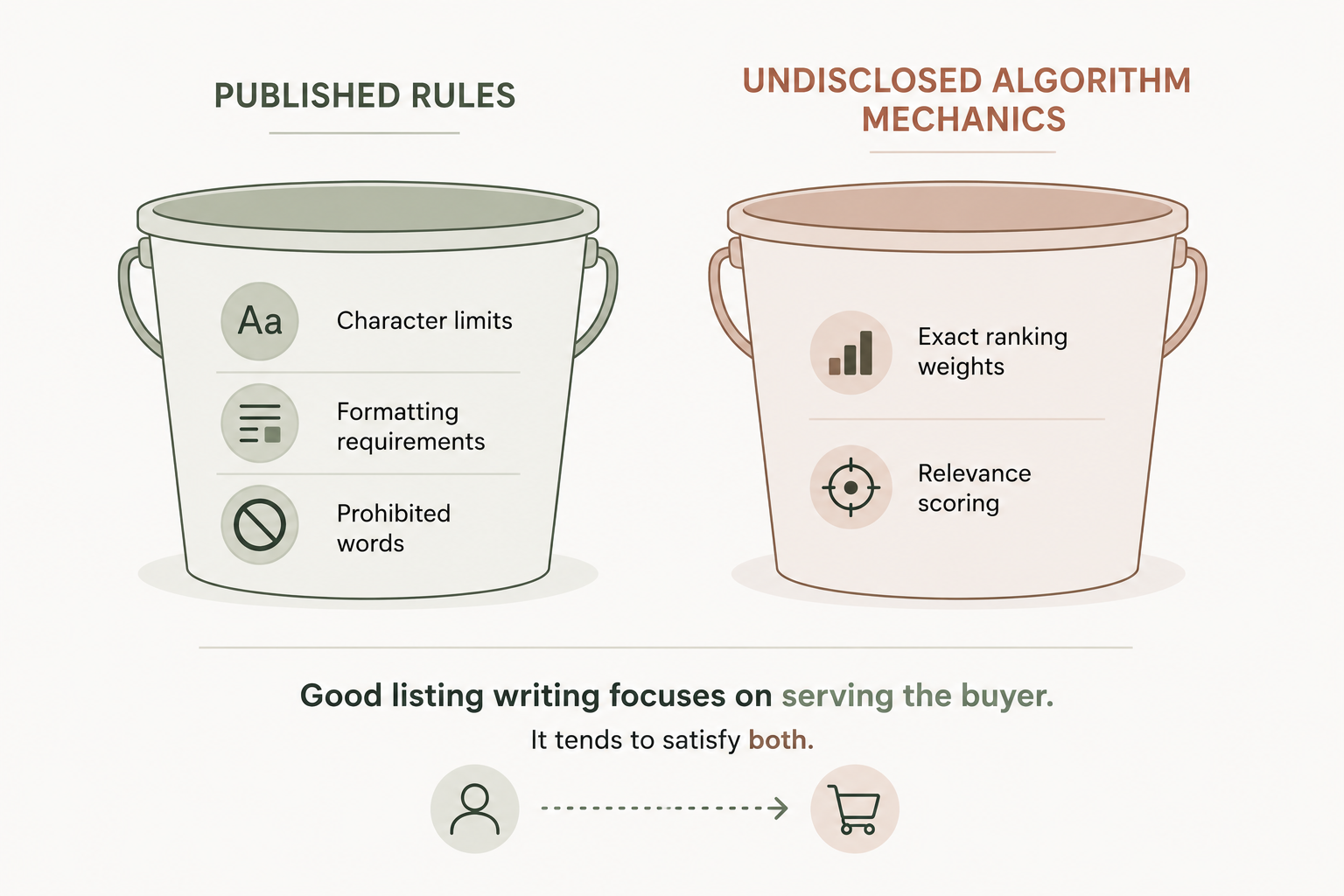
Here's where the myths break down against what platforms actually say:
- Myth — "Stuff your title and tags with every keyword you can fit": Reality: Etsy, Shopify, Amazon, TikTok Shop, and Google all explicitly discourage or penalize keyword stuffing in their own guidance. It doesn't read as more relevant — it reads as spam, to shoppers and to search systems alike.
- Myth — "Use bold, superlative language like 'best' or 'amazing' to stand out": Reality: Amazon and TikTok Shop officially prohibit subjective, unverifiable adjectives in product titles. Claims like "best-selling" or "amazing quality" aren't just unpersuasive — they can violate listing policy outright.
- Myth — "Longer descriptions always perform better": Reality: Shopify's own guidance frames description length as need-driven, not something to maximize. A description should be as long as it needs to be to answer real buyer questions — no more.
- Myth — "Write for the algorithm first, buyers second": Reality: Etsy, TikTok Shop, and Shopify all explicitly instruct sellers, in their own official guidance, to write for buyers first. There isn't a hidden "algorithm voice" that outperforms clear, honest, human writing.
To see the difference, compare these two versions of the same listing:
Keyword-stuffed version:
Title: "Best Ceramic Coffee Mug Cute Coffee Mug Gift Mug Cute Mugs for Women Coffee Cup Birthday Gift Mug 12oz"
Description snippet: "Coffee mug cute mug ceramic mug gift mug best coffee mug for women mug gift mug birthday mug cute coffee mugs..."
Corrected version:
Title: "12oz Ceramic Coffee Mug with Speckled Glaze — Handmade Birthday Gift"
Description snippet: "This 12oz mug is hand-thrown in stoneware clay and finished with a speckled reactive glaze, so no two mugs look exactly alike. It's microwave- and dishwasher-safe, and sized for a generous pour of coffee or tea."
The corrected version still contains the core keywords — "ceramic coffee mug," "12oz," "gift" — but they appear once, in context, doing real descriptive work. That's the whole shift this guide is asking you to make.
Chapter 2: Write for Buyers, Not Products
This is the idea everything else in this guide builds on: a listing doesn't sell by persuading a stranger. It sells by reducing a stranger's uncertainty about whether this specific product solves their specific problem. Buyers aren't an audience waiting to be won over by a good pitch — they're more like a skeptical detective building a case file. Every sentence and every photo either adds evidence to that case, or it gets ignored.
That reframing matters because it changes what "good copy" even means. A detective doesn't want to be impressed — they want their open questions closed. "Will this fit?" "What is it actually made of?" "What does shipping cost, and when will it arrive?" "Why do the photos and the reviews sometimes seem to describe different products?" If your listing doesn't address these directly, the buyer doesn't finish being persuaded — they simply run out of evidence and move to the next listing.
This lines up with independent research on why shoppers abandon carts and listings. The Baymard Institute — an independent e-commerce research group, not affiliated with any single marketplace — has found that unclear sizing, unclear materials, unclear shipping costs, and inconsistent information across product variants are recurring reasons buyers walk away. This is industry-consensus research, not a claim made by any platform itself, but it's consistent enough across studies to treat as a reliable pattern: ambiguity, more than price, is often what kills a sale.
It also helps to borrow the "jobs-to-be-done" framework, developed out of Clayton Christensen's work at the Christensen Institute. The idea is that buyers don't just buy a product — they "hire" it to do a job, and that job usually has three layers: a functional job (what it literally does), an emotional job (how it makes them feel), and a social job (how it makes them look to others). A phone case's functional job is protecting a phone; its emotional job might be reducing anxiety about dropping an expensive device; its social job might be expressing personal style. Writing to only the functional layer is why a lot of technically accurate listings still feel flat. As one illustrative example of what happens when copy speaks to the right job: a CXL case study documented an 8.72% conversion lift after rewriting product copy around the buyer's underlying motivation rather than just its features. That's one specific test result, not a guaranteed outcome you should expect to replicate — treat it as a proof of concept for the idea, not a benchmark.
Buyer's internal monologue, while scanning a listing: "Okay, what is this actually — is it what I searched for? ...Does it come in my size? ...Wait, is this fabric going to feel cheap? ...Does the second photo match the first, or is this a bait-and-switch? ...What does 'ships in 3-5 days' actually mean for arrival before the weekend? ...Fine, I'll add it to cart, but I'm still not sure."
Those six questions from the introduction — what is it, is it for me, can I trust it, how will it fit into my life, is it worth the price, what happens next — are exactly the evidence a buyer is collecting. Every chapter from here on shows you how to answer a specific subset of them: titles answer the first two, descriptions and photos answer the middle three, and your listing's CTA and policies answer the last one.
Chapter 3: Write Titles That Get Clicked
A title has one job before it can do anything else: let a buyer instantly recognize whether this is the product they're looking for. Using the Six Buyer Questions, a title's entire job is answering the first two questions — what is it and is it for me — in about five words. That single job explains most of what makes a title work or fail.
Compare a vague, generic title to a specific one:
Vague: "Women's Top"
Specific: "Women's Linen Button-Down Top, Short Sleeve, Relaxed Fit"
The vague title forces the buyer to open the listing just to find out basic facts the title should have already told them. The specific title answers "what is this, exactly" in the first five words, using the same plain language a buyer would type into a search bar. This is arguably the highest-leverage change you can make to any listing — titles get scanned in search results in a second or two, and a title that doesn't immediately register as relevant often never gets clicked at all, regardless of what's in the description.
A few general principles apply across every marketplace:
- Lead with what the product actually is — not a brand slogan, not a superlative, the plain noun phrase a buyer would use.
- Write in natural language, not a keyword string. "Ceramic mug speckled glaze handmade gift" reads as spam; "Handmade Ceramic Mug with Speckled Glaze" reads as a title.
- Prioritize readability. If a human has to reread your title to parse it, a search system has no advantage over that human — it's parsing the same words.
Buyer Question: "Is this even the right category of thing?" A title that buries the actual product noun under adjectives and occasion words leaves this unanswered — and an unanswered "what is it" means the buyer never gets to your second, third, or fourth question at all.
🏷️ Marketplace Note: Shopify doesn't impose a character limit on the product title itself — that field is unrestricted. What Shopify does regulate is a separate SEO/meta title field, with a soft guideline of roughly 60 characters for how it displays in search engine results. That's a genuine structural difference from Etsy, Amazon, and TikTok Shop, where the product title customers see on the listing page is itself the regulated field.
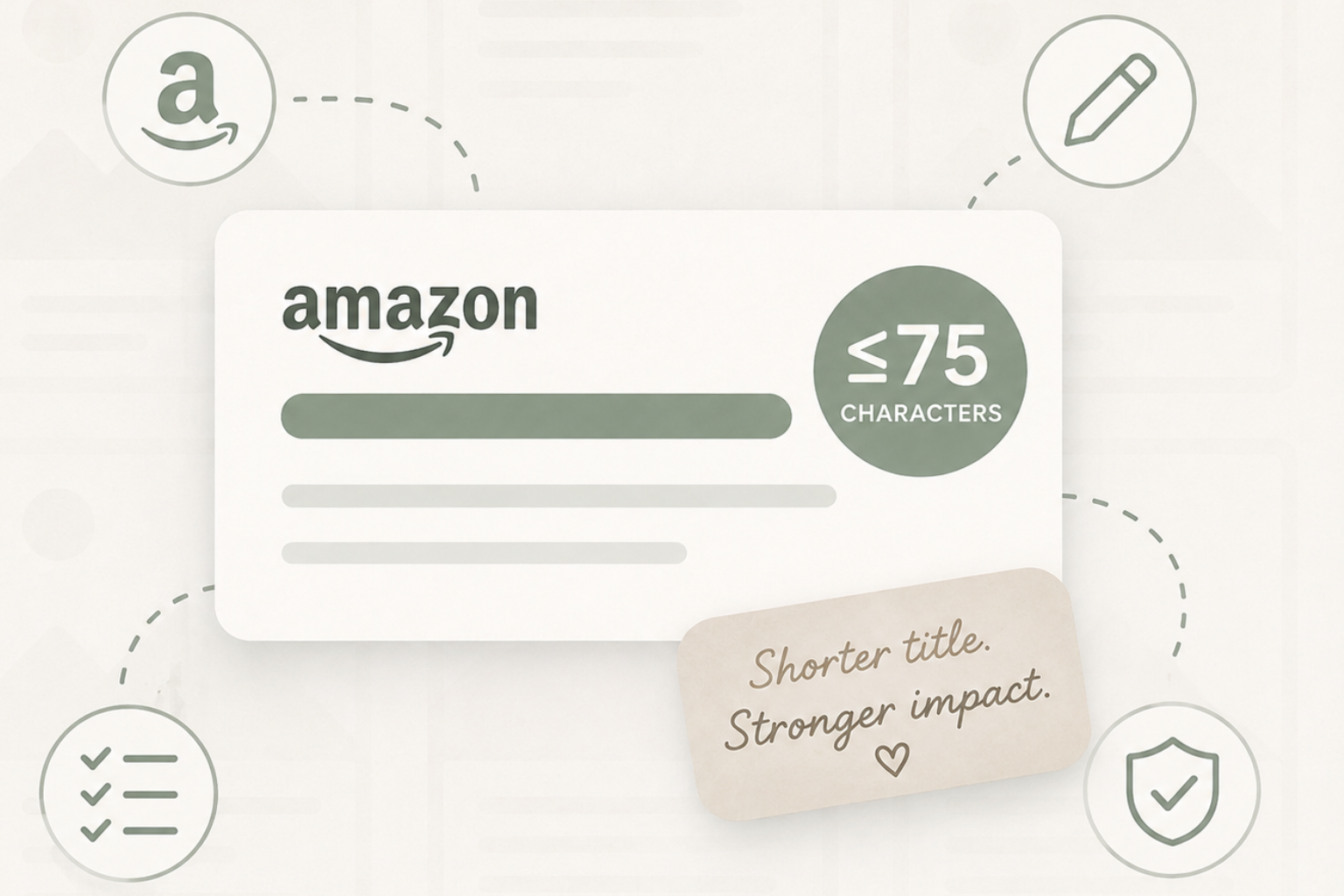
🏷️ Marketplace Note: Amazon's title rules changed recently. As of the July 27, 2026 update, Amazon caps titles at 75 characters and introduces a separate "Item Highlights" field to hold overflow detail that used to get crammed into the title. If you've been writing long, detail-packed Amazon titles out of habit, this is worth revisiting — extra specifics now belong in Item Highlights, not stuffed into the title.
Etsy has its own established title conventions worth a brief mention — front-loading the most important search terms while still reading naturally — but because this guide is meant to apply across platforms, we won't do a full platform-by-platform title breakdown here. That comparison lives in Chapter 7.
Here's the same fix applied to a completely different product:
Vague: "Wireless Earbuds"
Specific: "Wireless Earbuds with Noise Cancellation, 30-Hour Battery, USB-C"
Same pattern: the vague version leaves "is it for me" completely unanswered — a buyer who specifically needs noise cancellation or long battery life has no way to tell from the title alone. The specific version answers "what is it" and "is it for me" in the same breath, which is exactly what a title's one job requires.
Chapter 4: Write Descriptions That Remove Doubt
A description's job is to keep resolving the uncertainty the title started to address. Using the Six Buyer Questions, this is where you answer can I trust it, how will it fit into my life, and is it worth the price — the three questions a title doesn't have room for. Most weak descriptions fail the same way: they don't answer any real question. Compare these two:
Weak: "This bag is a great addition to any wardrobe. Made with care and attention to detail, it's perfect for everyday use or a special occasion."
Improved: "This bag holds a 13-inch laptop plus a water bottle in the main compartment, with a separate zip pocket for cards and keys. It's made from water-resistant canvas, so light rain won't soak through, and the strap adjusts from a crossbody to a shoulder length."
The weak version could describe almost any bag — it makes the buyer do all the work of figuring out whether it fits their actual need. The improved version front-loads the two or three things a buyer in the market for a bag is actually trying to resolve: what fits inside, what it's made of, and how it's worn. Notice that it does this without a single superlative.
A useful way to organize this: separate features from benefits, and lead with whichever one answers the buyer's question fastest. "Water-resistant canvas" is a feature; "light rain won't soak through" is the benefit that feature produces. Sometimes stating the feature is enough because the benefit is obvious; sometimes you need to spell out the benefit explicitly because it isn't.
Storytelling has a place in a description, but it belongs after the essentials, not instead of them. A short story about why you designed a product a certain way can add emotional resonance once a buyer already knows the size, material, and function — it shouldn't be the first three sentences a buyer has to wade through before finding a practical answer.
Formatting matters as much as wording. Short paragraphs and bullet points let a buyer scan for the specific answer they need instead of reading start to finish — some buyers read carefully in order, others skim and react to whatever stands out first, and a well-formatted description serves both without extra effort.
One more before/after, because this is the highest-leverage habit in the whole guide:
Weak: "These earrings are a beautiful statement piece that will elevate any outfit."
Improved: "These earrings are lightweight titanium, so they're comfortable for all-day wear even at 2.5 inches long. They're hypoallergenic and safe for sensitive ears, and the hooks are sealed so they won't tarnish or turn green."
The weak version never gets past "is it worth the price" because it never actually says anything — it could be pasted onto any pair of earrings on the internet. The improved version answers "how will it fit into my life" (comfortable all-day wear), "can I trust it" (hypoallergenic, sealed hooks, won't tarnish), and implicitly justifies the price through specifics, without a single adjective doing the work instead of a fact.
🏷️ Marketplace Note: Amazon's description field is plain text only — no bold, no bullets, no HTML formatting. Amazon tolerates a single line break at most. If you want structured, scannable selling points on Amazon, that content belongs in the separate bullet-points field, not in the description itself. Copy-pasting a nicely formatted description from another platform directly into Amazon's description field will strip the formatting and can make it harder to read, not easier.
Chapter 5: Photos Sell What Words Can't
Words and photos answer different classes of buyer questions. Words are better at explaining things that aren't visible — materials, dimensions, care instructions, what's included. Photos are better at demonstrating things that are hard to put into words — how something actually looks in use, its true color and texture, and its scale relative to something familiar. Using the Six Buyer Questions, photos are often what actually convinces a buyer on "is it for me," "can I trust it," and "how will it fit into my life" — a well-written sentence can assert any of those, but a photo proves it.

Think of it as the difference between an instruction manual and a live demo. An instruction manual (your description) tells you precisely what something is and how it works. A live demo (your photos) shows you what that actually looks like in practice. You want both, because they resolve different doubts — a buyer who's fully informed by your words can still hesitate until a photo confirms it visually.
A few things every product photo set should cover:
- Primary image: This is the single most important photo in your listing — it's what shows up in search results before a buyer ever clicks in. It needs to clearly and accurately represent the product on its own, without relying on other photos for context.
- Lifestyle vs. detail shots: Lifestyle photos show the product in use or in context, helping a buyer imagine owning it. Detail shots zoom in on texture, stitching, hardware, or other close-up specifics that a wide shot can't capture. Most listings benefit from both.
- Scale reference: A product photographed alone, with nothing to compare it to, makes size genuinely hard to judge. A hand holding it, a coin next to it, or a model wearing it gives a buyer an instant, reliable sense of actual size.
- Variation images: If a product comes in multiple colors, sizes, or styles, each meaningfully different variation should have its own representative image, not just one photo standing in for all of them.
🏷️ Marketplace Note: Amazon's main image requirement isn't a style preference — it's a hard, enforced rule. The main image must be shot on a pure white background (RGB 255, 255, 255), with no lifestyle staging, no props, and no overlaid text. This directly contradicts generic "use a lifestyle hero photo" advice you'll find elsewhere, and Amazon does enforce it. Compare that to Etsy, which requires a minimum image size of 635 pixels with no background rule at all, and TikTok Shop, which requires a minimum of 600 pixels and recommends — but doesn't require — a white background. The same "best" primary photo on Etsy could be a policy violation on Amazon.
The difference between a photo set that resolves doubt and one that leaves it open is usually about completeness, not skill:
Bad photo sequence: one dim, slightly blurry photo of the product alone on a cluttered desk. Nothing else.
Good photo sequence: a clean, well-lit primary image; a second photo showing the product in use; a close-up of texture or construction detail; a photo with a coin or hand for scale; one photo per color or size variation offered.
Nothing in the "good" version requires professional equipment — it requires deciding in advance which of the six buyer questions each photo is responsible for answering, then making sure none of them get skipped.
Buyer Question: "Will this actually fit?" Your title can't answer that. Your photos and description can.
Chapter 6: Use Keywords Naturally
Chapter 1 introduced the tension between writing for search systems and writing for buyers, and Chapter 2 introduced the idea that buyers have their own language for describing what they want. This chapter puts those two ideas together into one practical habit: the keywords worth using are the words your buyers already use.
Start from the buyer's language, not a keyword list
Revisit the jobs-to-be-done thinking from Chapter 2. If a buyer is searching for a bag to "hire" for commuting with a laptop, they're far more likely to search "laptop bag for commuting" than a generic term like "premium accessory." Your best keywords usually come from the words a real buyer would type, not from a list of high-volume terms disconnected from what the product actually does.
Weave keywords in — don't stack them
The goal is for a keyword to appear because it's the accurate word for that part of the product, not because it needs to be present a certain number of times. A title, a description, and a platform's tag fields (where available) are each a chance to include a relevant term once, in context — not a chance to repeat the same term four different ways.
Recheck against Chapter 1's myths
If a sentence you've written would only make sense to a search system and not to a person reading it out loud, it's stuffed — go back and rewrite it in plain language. This chapter isn't introducing new theory; it's a habit for applying what you've already learned every time you sit down to write a listing.
Chapter 7: Write for Every Marketplace
The buyer is the same person, asking the same six questions, no matter where they're shopping. What changes from platform to platform isn't the psychology — it's the rules for how you're allowed to answer.
- Etsy: Discovery marketplace
Amazon: Policy-heavy
Shopify: Brand experience
TikTok Shop: Mobile-first
Etsy shoppers are often browsing rather than searching for one exact product — they're closer to wandering a curated market than typing a precise query into a database. Listings that lean into personality, story, and specific human detail tend to do well, because part of what Etsy buyers are there for is the discovery itself, not just the transaction.
Amazon shoppers usually already know what they want and are comparing near-identical options side by side. That's also why Amazon enforces its listing rules so strictly — plain-text descriptions, a mandatory white background on the main image, a tight title cap. Compliance matters as much as persuasion here, because a suppressed or rejected listing never gets the chance to answer any buyer question at all.
Shopify gives you a store that's entirely your own, which means there's no shared marketplace ranking system to satisfy. Your "rules" come from your own brand and whatever external channels — Google, social, ads, email — send traffic to you. This is the one place in this guide where you have close to total creative control over how you answer the six buyer questions.
TikTok Shop shoppers usually arrive mid-scroll, from a video, on a phone. Listings need to hold up at a glance, which is why TikTok Shop's own guidance leans so heavily on a clean, legible primary image and a title that still reads clearly at a small size.
One more distinction worth carrying with you as you move between platforms: some of what governs visibility is published and knowable — character limits, formatting rules, image requirements, all covered in the Marketplace Notes earlier in this guide. Some of it genuinely isn't published anywhere, on any platform — the exact weighting behind a ranking algorithm, for instance. Follow the rules that are published. Don't waste effort chasing the ones that aren't.
Chapter 8: Write for Humans. AI Will Follow.
AI-powered shopping tools — chat-based assistants, AI shopping agents, conversational search — are a newer surface for product discovery, but they're not a new skill to learn. They're the same fundamentals, read by more systems. Write a clear, specific, accurate listing, and you're already doing the work that both traditional search and AI discovery systems reward.
A useful way to think about this: a well-organized filing cabinet is just as useful to a new intern as it is to the person who built it. You don't build a second, differently organized cabinet for the intern — you keep one cabinet well-labeled and let both use it. An AI shopping agent reading your listing is that intern: it benefits from the same clarity a human buyer does, not a separate set of "AI-friendly" tricks.
Here's what's actually disclosed, platform by platform, and it's important to keep official confirmations separate from industry speculation:
- Etsy: The most detailed public disclosure of the four. Etsy has officially described a semantic relevance framework that uses large language models to understand search intent, along with "algotorial" curation that blends algorithmic and human-curated results.
Amazon: Amazon has officially confirmed and described Rufus and Alexa for Shopping as AI-powered shopping assistants. Amazon has also officially confirmed COSMO, a separate AI system, via a peer-reviewed research paper. However, the specific claim that "COSMO powers Rufus" is not something Amazon has confirmed — that connection is industry inference, not an official statement, and should be treated accordingly.
Shopify: Shopify Catalog and its Universal Commerce Protocol are built to let external AI agents — tools like ChatGPT, Gemini, or Copilot — discover and even transact with products listed on Shopify stores. This is a meaningfully different kind of "AI discovery" than Etsy's or Amazon's internal search AI: it's about outside AI agents finding your Shopify products, not an internal AI ranking system inside Shopify itself. Don't conflate the two.
TikTok Shop: The least disclosed of the four. TikTok Shop has confirmed that its Shop tab functions as a search engine in its own right, and has referenced an A.C.E. discovery framework, but has not published technical detail comparable to what Etsy or Amazon have shared.
None of this changes what you should actually write. Writing clearly and specifically isn't a new tactic for AI discovery — it's the same practice this whole guide teaches, and these systems are simply another audience that already rewards it. There's no guarantee that any specific optimization will move you up in an AI assistant's results, and no platform has published rules detailed enough to promise that. Treat AI discovery as a reason to keep doing the fundamentals well, not as a new checklist to chase.
Chapter 9: Common Product Listing Mistakes
Most of these have already been covered in depth in earlier chapters — this is a quick reference, not a new set of lessons.
- Vague titles: A title that could describe a hundred different products forces buyers to open the listing just to find out basics the title should have covered (see Chapter 3).
- Missing information: Leaving out sizing, materials, or shipping timelines forces buyers to guess — and uncertain buyers tend to leave rather than ask (see Chapter 2).
- Keyword stuffing: Repeating the same term across a title and description doesn't read as more relevant to a shopper or a search system — it reads as spam (see Chapter 1).
- Poor photos: A single photo, shot with poor lighting or with nothing to indicate scale, leaves size and quality questions unanswered (see Chapter 5).
- Weak calls to action: A description that never clearly states what's included, how to select a variant, or what happens next leaves a convinced buyer without a clear next step.
- Walls of text: An unbroken paragraph forces every reader into "systematic" mode whether they want to be there or not, and loses the impulsive scanners entirely (see Chapter 2).
Worth noting: Shopify doesn't publish an official "common listing mistakes" article, so there's no platform-specific guidance to cite there beyond general best practice. Etsy does publish official guidance about common mistakes, but it's framed around running a shop broadly — policies, customer service, shop setup — rather than listing content specifically. It's worth being accurate about that distinction rather than implying either platform has issued listing-content guidance it hasn't.
Chapter 10: A Repeatable Product Listing Checklist
Use this before publishing or revising any listing. Every check below ultimately serves one of the six Buyer Questions from the introduction — this list just breaks them into specific, checkable actions.
Titles
- Does the title lead with what the product plainly is?
- Is it written in natural language a buyer would actually search, not a keyword string?
- Have you removed subjective adjectives like "best" or "amazing"?
- Does it fit the platform's actual title rules (character limit, if any)?
Descriptions
- Do the first two or three sentences answer the buyer's most likely real question?
- Have you distinguished features from benefits where the benefit isn't obvious?
- Is any storytelling placed after the essential facts, not before them?
- Is it formatted for both a careful reader and a quick scanner (short paragraphs, bullets where the platform allows them)?
Photos
- Does the primary image clearly and accurately represent the product on its own?
- Do you have at least one lifestyle/context shot and one close-up detail shot?
- Is there a scale reference somewhere in the set?
- Does every meaningfully different variation have its own image?
- Does the photo set follow this specific platform's actual photo rules (background, minimum size)?
Keywords
- Do your keywords come from language your buyers actually use, not a generic list?
- Does each keyword appear because it's accurate, not because it's repeated for volume?
- Read it out loud — does every sentence make sense to a human, not just a search system?
Marketplace-specific checks
- Have you confirmed this platform's current title character limit and any recent changes?
- Have you confirmed this platform's description formatting rules (HTML support, line breaks)?
- Have you confirmed this platform's photo background and size requirements?
- Have you avoided assuming a ranking factor is confirmed when the platform hasn't disclosed it?
FAQ
Should my title match across all marketplaces if I sell on multiple?
Not exactly — each platform has different title rules (length limits, allowed language), so a title built for Amazon's 75-character cap may need trimming for Etsy, and a Shopify title has no character limit to match at all. Keep the core product description consistent, but adapt the exact wording to each platform's mechanics.
Do I need different photos for each platform?
Often yes, at least for the primary image. Amazon's requirement for a pure white background is enforced and would violate policy if used unchanged from a lifestyle-first Etsy or TikTok Shop listing. Secondary detail and lifestyle shots can usually be reused across platforms.
Does a longer description help my SEO?
Not on its own. Shopify's own guidance frames length as need-driven rather than something to maximize, and none of the platforms covered here reward length by itself. A shorter description that clearly answers real buyer questions outperforms a longer one padded with repetition.
How much should I worry about AI-powered search right now?
Not much beyond what you're already doing. AI discovery tools reward the same clarity and specificity that traditional search and human buyers reward — there's no separate AI-specific writing technique confirmed to work, and no platform has promised ranking or sales outcomes from any particular tactic.
Conclusion
Every product listing is answering questions. If buyers still have questions, they hesitate. If your listing answers them before they're asked, buying becomes easy.
That's the Six Buyer Questions in one sentence: what is it, is it for me, can I trust it, how will it fit into my life, is it worth the price, what happens next. Answer all six, in your own words, on whichever marketplace you sell on, and you've written a listing built to convert — not by persuading harder, but by leaving nothing for the buyer to wonder about.
You now know how to write a high-converting product listing. The challenge is doing it consistently for every product, every marketplace, while keeping up with changing platform requirements. That's exactly what ListSage was built for. Describe your product once, choose your marketplaces, and get ready-to-post product listings in seconds — without the research, rewriting, or guesswork.
Create your first listing free →
.png)
Lindsey Records
Founder of ListSage and a content strategist with 15+ years of experience in SEO, ecommerce, and AI. After growing her own Etsy and Shopify stores, she built ListSage to eliminate the hours of research, prompting, and rewriting required to create high-performing product listings.