.png)
This guide reflects Etsy's published guidance as of July 2026 and is reviewed periodically as Etsy updates Search.
Introduction & What You'll Learn
Most Etsy SEO advice falls into one of two categories: outdated or oversimplified. If you sell on Etsy, you've probably heard a dozen conflicting theories about "the algorithm" — renew your listings for a boost, stuff your title with every keyword you can think of, buy Etsy Plus because it supposedly helps you rank. Most of that advice is outdated, misremembered, or was never true in the first place.
This guide replaces theory with mechanics. You'll learn how Etsy search actually decides what to show a shopper, what changed in the April 2026 title guidance, and which of your daily habits genuinely move the needle versus which ones just feel productive. We'll separate what Etsy has explicitly confirmed from what ListSage recommends as practical follow-through, so you always know which is which.
By the end, you'll have a repeatable checklist you can run on every listing, a clear list of myths to stop believing, and an honest picture of what even Etsy itself hasn't published. Etsy SEO isn't a trick to learn once — it's a skill you build, the same way you'd build any other part of your shop. And if Etsy isn't your only sales channel — plenty of sellers here also list on Shopify, TikTok Shop, or Amazon — the mental models in this guide (query matching vs. ranking, buyer intent, listing quality) transfer directly; only the specific mechanics change from platform to platform.
How Etsy Search Actually Works
Think of your listing the way you'd think of a dating app profile. Getting shown to someone isn't the same as getting chosen by them — those are two separate problems, solved in two separate steps. Etsy search works the same way, and almost every piece of seller advice you've heard falls into one of these two buckets without saying so.
Phase one is query matching. When a shopper searches "minimalist gold necklace," Etsy first has to decide whether your listing is even eligible to appear at all — like a dating app filtering profiles by the criteria someone swiped in. This is a matching problem, not a beauty contest: it checks whether your title, tags, attributes, description, first photo, and reviews contain signals that connect to what was searched. If none of your fields mention "minimalist" or "gold," you don't get filtered in, no matter how good your shop is.
Phase two is ranking. Once a pool of listings has matched the query, Etsy decides who gets shown first — and this is where quality signals take over from wording. Two listings can match a query equally well and still land in very different positions, because ranking asks a different question than matching does: not "does this listing mention the right words," but "is this a listing shoppers should trust and want to click."
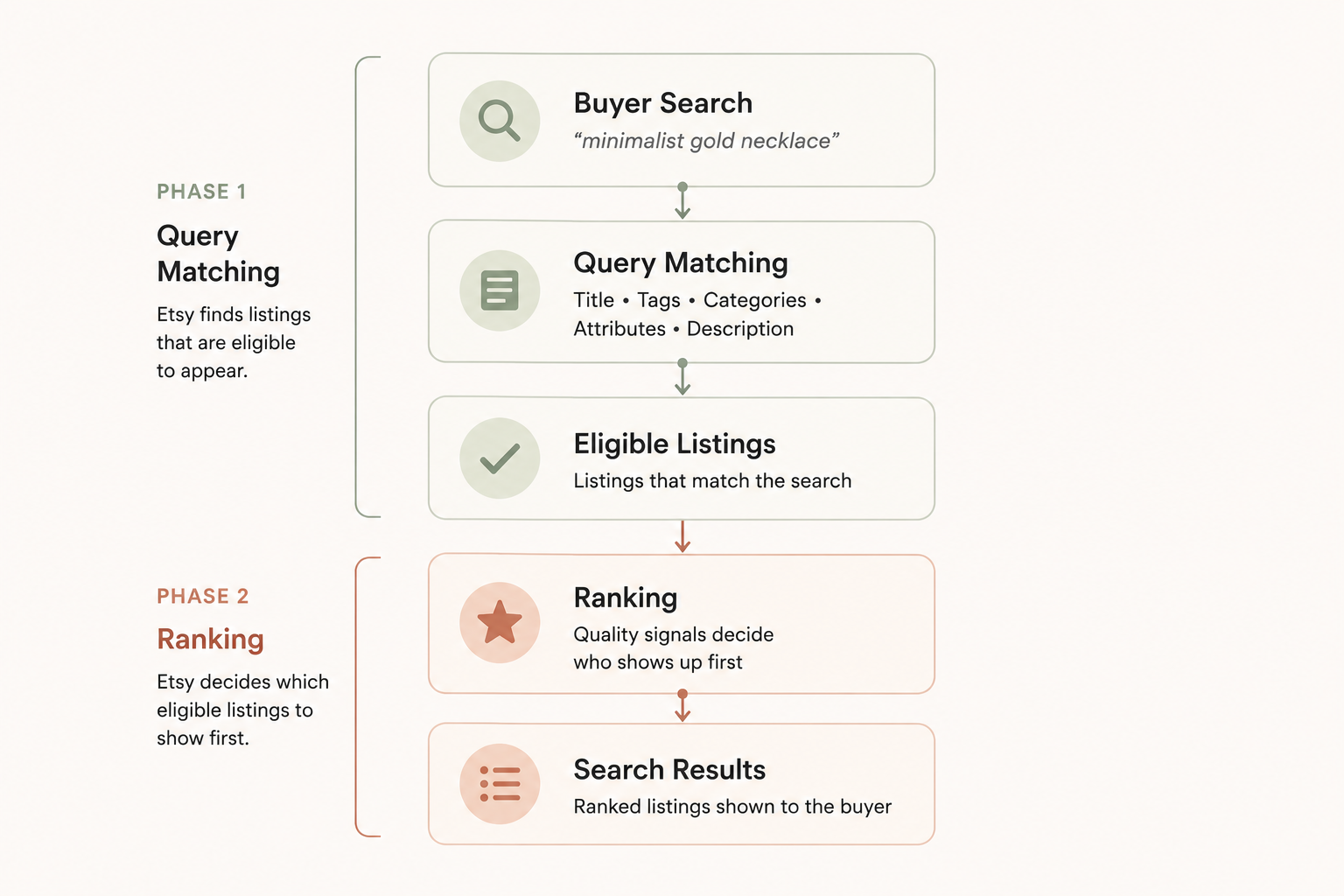
This distinction matters because it tells you where to spend your effort. Keywords get you into the room. They don't get you the best seat. Confusing the two is the root of most Etsy SEO myths, including the belief that repeating a keyword everywhere will push you higher — repetition can only ever help you match, and Etsy's matching already recognizes root words and plurals without you needing to repeat anything.
It's worth being explicit about how this differs from the search engine most sellers already know:
- Etsy SEO: Closed marketplace — you're competing only against other Etsy listings
Google SEO: Open web — competing against every indexed page, including Etsy's own listings - Etsy SEO: Structured fields: title, tags, attributes, categories, description
Google SEO: Unstructured content, backlinks, site architecture, domain authority - Etsy SEO: Shop and listing quality signals (reviews, response time, shipping) directly feed ranking
Google SEO: Off-site authority signals (backlinks, domain trust) carry more weight - Etsy SEO: Shopping intent is assumed — most searches are close to a purchase decision
Google SEO: Intent varies widely — informational, navigational, transactional
In This Guide
- Introduction & What You'll Learn
- How Etsy Search Actually Works
- How Buyers Actually Search (Intent & Long-Tail Queries)
- Keyword Research: Spread Keywords Across Your Entire Listing
- Titles: The 2026 Rewrite
- Tags, Categories & Attributes: Completing the Picture
- Descriptions That Do Real SEO Work
- Photos: Your Highest-Leverage Ranking Lever
- Listing Quality & Customer Experience: The Score Running in the Background
- AI & Product Discovery: Already Here, Not Coming Later
- Etsy SEO Myths, Debunked
- What Etsy Won't Tell You (and Why That's Fine)
- Your Repeatable Etsy SEO Checklist
- FAQ
- Conclusion & Next Step
Once a listing matches, ranking draws on a defined set of quality signals. Here's what actually feeds it:
- Ranking Factor: Relevancy
What It Measures: How closely your matched fields align with the query - Ranking Factor: Shop Quality
What It Measures: Overall performance signals across your shop - Ranking Factor: Listing Quality
What It Measures: Signals on the individual listing, including offering US shipping under $6, which Etsy has prioritized in ranking since October 2024 - Ranking Factor: Customer Service Quality
What It Measures: Average review rating, first-message response within 48 hours, case rate kept under 0.25%, on-time shipping - Ranking Factor: Listing Engagement Rate
What It Measures: How shoppers interact with the listing once they see it - Ranking Factor: Recency
What It Measures: A temporary visibility signal for newer activity — it fades, it isn't farmable - Ranking Factor: CSR Personalization
What It Measures: Etsy tailors results to a shopper's own behavior and history
And just as important — what's explicitly not a ranking factor, despite persistent seller folklore:
- Not a Ranking Factor: Etsy Plus
What It Actually Does: Shop customization and tools subscription — no ranking effect - Not a Ranking Factor: Star Seller
What It Actually Does: A trust badge shown to shoppers, based on the same service metrics above — a signal, not a separate ranking input - Not a Ranking Factor: Etsy Ads
What It Actually Does: A paid placement, separate from organic ranking
🦉 Sage Tip: Every time you're tempted to ask "will this help my ranking," ask a more precise question first — "does this help me match more searches, or does this help my quality score?" The answer usually tells you whether you're solving the right problem.
How Buyers Actually Search (Intent & Long-Tail Queries)
Picture a food truck line at lunch. Everyone shouts something short and generic — "tacos," "coffee" — and the truck serves whoever's loudest and closest. That's what a broad, one-word Etsy search looks like: thousands of listings competing for the same few words, most of them a rough match at best.
Now picture hiring a caterer for a wedding. You don't just say "food" — you give them your guest count, dietary restrictions, theme, and date. Fewer caterers can fulfill that exact spec, but the ones who can are a near-perfect match, and you're far more likely to book one of them. That's a long-tail search.
Compare the two directly:
- Query: "jewelry"
What Happens: Enormous match pool, low specificity, shopper is still browsing, conversion is low - Query: "minimalist gold birth-flower necklace for new mom"
What Happens: Small match pool, shopper knows exactly what they want, conversion is high for the few listings that qualify
This is why chasing the biggest, most generic keyword in your niche is usually the wrong instinct. You're not trying to win the loudest, most crowded line — you're trying to be the exact match for someone who already knows what they need. Long-tail phrasing across your fields — not stuffed into one field — is what lets that specific shopper find you.
Keyword Research: Spread Keywords Across Your Entire Listing
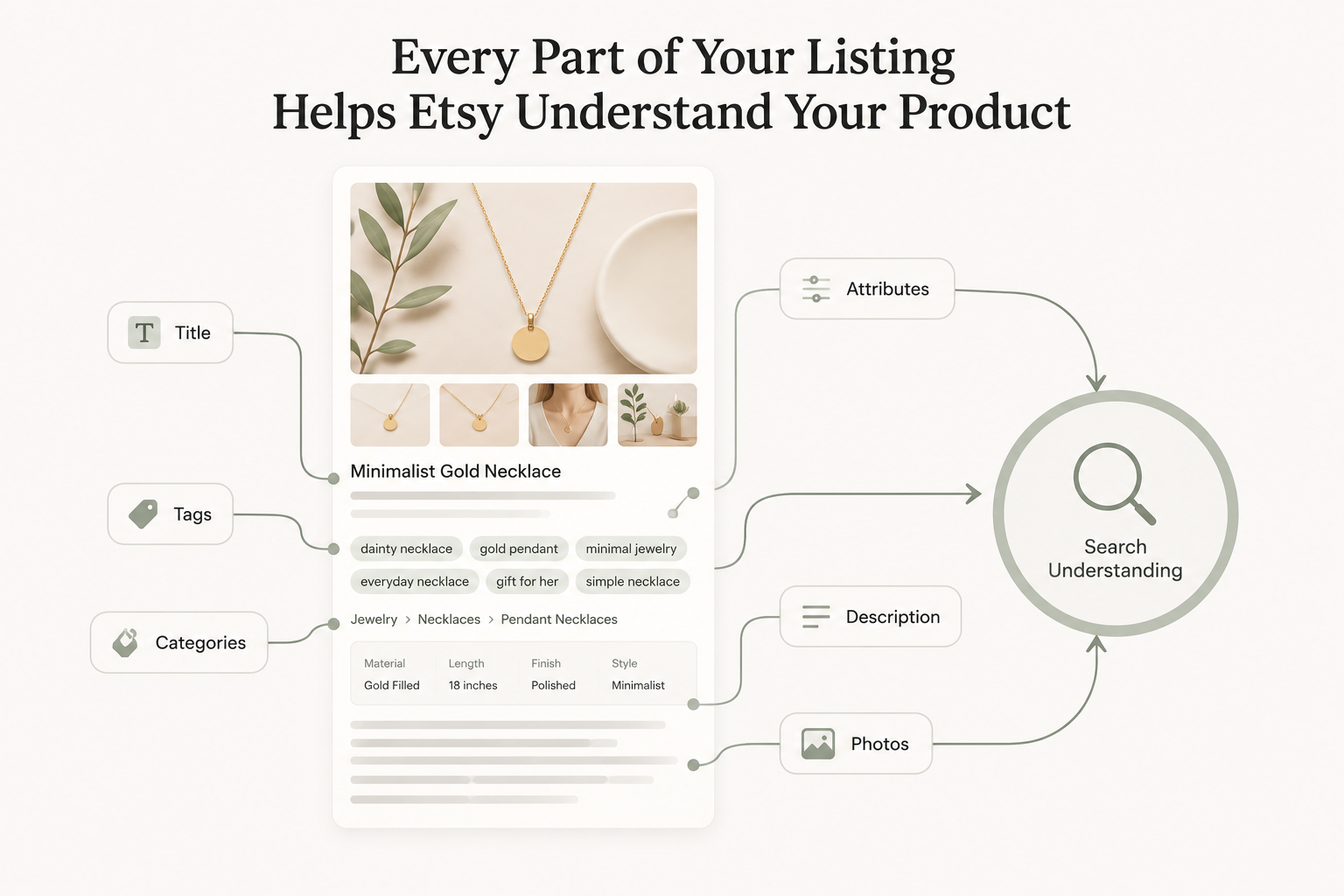
Here's a habit worth breaking early: thinking of "keywords" as something that lives only in your title. Etsy's search engine reads across five fields at once — title, tags, attributes, categories, and description — and query matching draws signal from all of them together. A keyword that never appears in your title can still get you matched, if it shows up somewhere else in that set.
That changes how you should brainstorm. Instead of trying to cram everything into one field, work through categories of phrasing and place them across the fields where they fit naturally:
- Descriptive — what the item literally is (e.g., "ceramic mug")
- Materials & techniques — how it's made (e.g., "hand-thrown stoneware")
- Who it's for — the intended recipient (e.g., "gift for coffee lover")
- Occasions — when it gets used or given (e.g., "housewarming gift")
- Solution-oriented — the problem it solves (e.g., "keeps coffee hot longer")
- Style — the aesthetic (e.g., "minimalist," "cottagecore")
- Size — dimensions or capacity shoppers filter by (e.g., "12oz mug")
Etsy's matching also does some work for you automatically: root words and plurals are matched without extra effort, so "necklace" and "necklaces" don't both need a slot. Some regional spelling variants are auto-matched too — but not all of them, and slang or niche regional terms generally aren't. If your audience searches in a dialect or slang term Etsy hasn't mapped, you need to add it yourself rather than assume it's covered.
🦉 Sage Tip: Before you write a single tag, write out your seven category list first. Sellers who brainstorm broadly before filling fields end up with genuinely different phrases in each slot — instead of thirteen versions of the same three words.
Titles: The 2026 Rewrite
If there's one piece of Etsy advice actively costing sellers visibility and clicks right now, it's old title formatting. On April 27, 2026, Etsy overhauled its title guidance, and the keyword-stuffed, pipe-separated title format that dominated seller forums for years is now the exact thing sellers need to undo.
The old logic treated a title like a filing cabinet — cram in every synonym, separate with pipes or commas, hope something matches. The new guidance treats the title more like a business card: one clear introduction, stated once, with the detail work happening elsewhere. If you want an image for it, tags and attributes are the filing cabinet — that's genuinely where the long list of variations belongs now.
The current rules, in practice:
- State the item once, as a noun — don't repeat it in different phrasing
- Lead with your top three objective descriptors
- Keep the whole title under roughly 15 words
- Remove subjective or aspirational language entirely ("beautiful," "perfect," "best")
- Remove price, sale, and shipping information entirely — none of that belongs in a title anymore
- Avoid repeated phrases anywhere in the title
- Word order does not affect ranking — but front-loading your most important terms still helps human click-through, since mobile displays truncate longer titles. That's a click behavior effect, not a ranking effect, and it's worth acting on for that reason alone
An AI title-writing tool is available if you want a starting draft to edit — treat it as a first pass, not a finished product.
- Old Approach: Repeats the product multiple ways
2026 Approach: States the product once, clearly - Old Approach: Packs in every synonym and adjective
2026 Approach: Leads with the top three real descriptors - Old Approach: Often 20+ words, pipe-separated
2026 Approach: Under ~15 words, plain phrasing - Old Approach: Includes "SALE," price, or shipping details
2026 Approach: Excludes all pricing and shipping language - Old Approach: Assumes word order changes ranking
2026 Approach: Optimizes word order for mobile click-through, not ranking
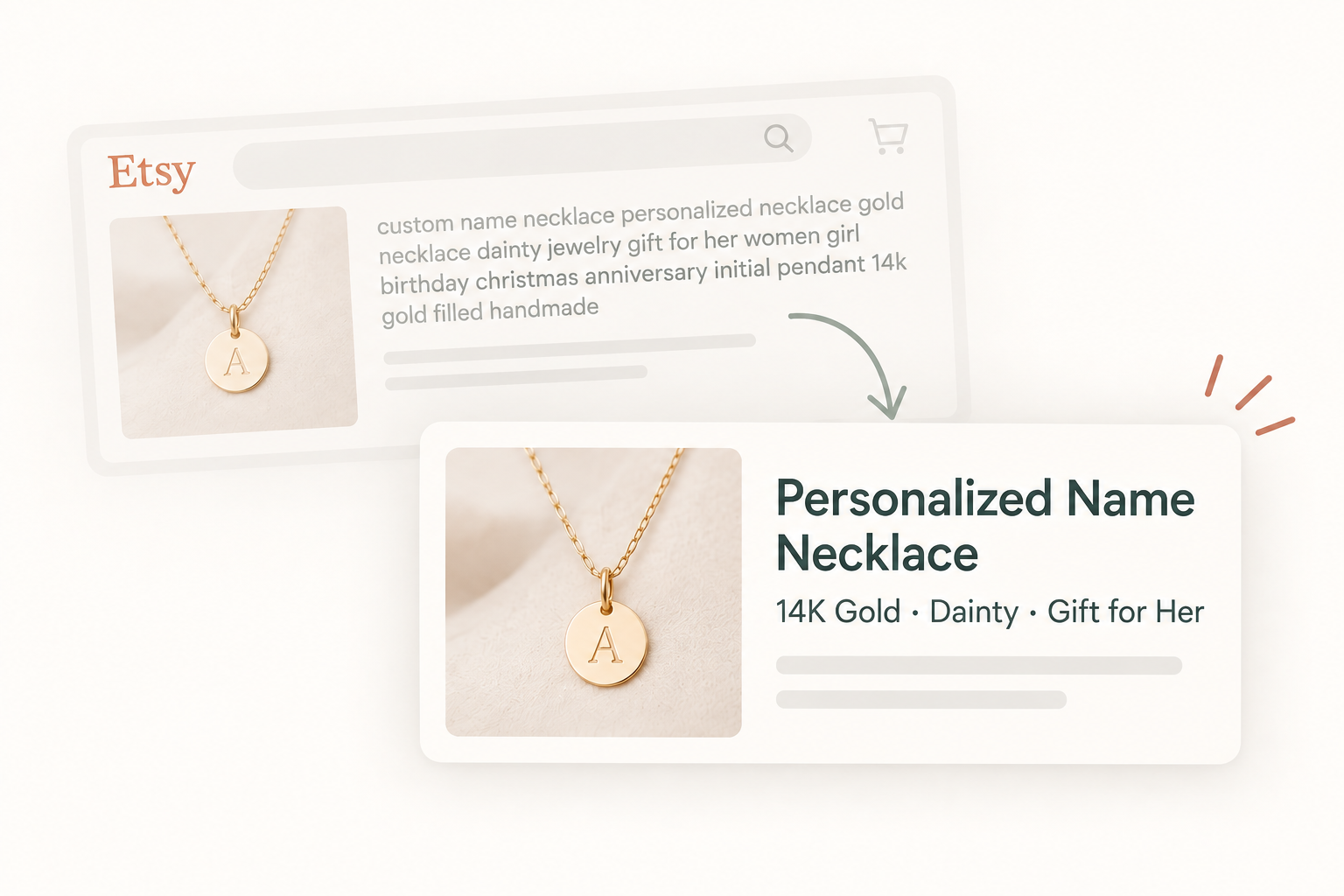
Before: "Gold Necklace | Minimalist Necklace | Dainty Necklace Gift for Her | Birth Flower Necklace | Personalized Jewelry | Christmas Sale | Free Shipping"
After: "Minimalist Gold Birth Flower Necklace, Personalized Gift for Her"
Notice the after version says "necklace" once, leads with the three descriptors that actually matter (minimalist, gold, birth flower), and drops every word that isn't the product itself.
Tags, Categories & Attributes: Completing the Picture
These three fields are more mechanical than titles or descriptions, so we'll move through them quickly.
Tags: You get 13 tag slots, each up to 20 characters. Use multi-word phrases rather than single words — a tag is a small amount of real estate, so make each one count. Don't duplicate phrases already covered by your category or attributes; that's wasted slots. Skip misspellings on purpose — Etsy auto-redirects common misspellings to the correct term, so a deliberately misspelled tag isn't gaining you anything. And keep tags in the language your actual shoppers use, not internal shop jargon.
Categories: Always pick the deepest, most specific subcategory available. This doesn't shrink your reach — a listing filed in a specific subcategory is still included when a shopper browses the broader parent category above it. There's no upside to staying vague here.
Attributes: Fill in every attribute that genuinely applies, and skip the ones that don't — don't guess just to fill a field. Attributes power the filter sidebar shoppers use to narrow results (color, size, material, and so on), so an unfilled attribute is a filter that can never surface you. Etsy's own data suggests attributes are filled for roughly half of listings across categories, which means the other half are invisible to anyone filtering by that trait. Increasingly, Etsy's systems can infer some gaps automatically — color swatches being a visible example — but that's a backstop, not a reason to skip the field yourself.
Bad tag set (repeats the title, repeats one word six times): "gold necklace," "necklace gift," "gold jewelry," "necklace for her," "gold gift necklace," "necklace necklace"...
Good tag set (13 distinct multi-word phrases spanning material, occasion, recipient, and style): "birth flower jewelry," "gift for new mom," "dainty layering necklace," "personalized birthday gift," "minimalist gold jewelry," "push present idea," "graduation gift her," "delicate everyday necklace," "custom flower pendant," "mothers day jewelry," "bridesmaid proposal gift," "boho gold necklace," "cottagecore jewelry gift" — each one covering different ground instead of restating the same idea.
Descriptions That Do Real SEO Work
Descriptions get treated like an afterthought by a lot of sellers, but the first few sentences are part of query matching — Etsy's search reads them along with your title, tags, and attributes. That means a description that just repeats your title word-for-word, or dumps in every keyword you can think of, is wasting a field that could be doing real work.
Write it the way you'd actually talk to a shopper, not the way you'd write a keyword list. Put the essential facts up top — what it is, what it's made of, dimensions, what's included — ideally in short bullets a shopper can scan in two seconds. Save your maker's story, the "why I started this shop" narrative, for the end. It's genuinely valuable for building trust and connection, but it's not what someone skimming search results needs first.
Before: "Gold necklace minimalist necklace dainty necklace birth flower necklace personalized necklace gift jewelry for her mom gift."
After: "This delicate birth-flower necklace is hand-finished in 14k gold-filled wire, personalized with the flower of your choice. Perfect for a new mom, a milestone birthday, or a quiet everyday reminder of someone you love."
The second version reads like a person wrote it, and it still carries every keyword the first one had — it just arranges them into something a shopper actually wants to read.
Photos: Your Highest-Leverage Ranking Lever
Roughly 90% of shoppers say photo quality is very or extremely important to their buying decision — which already tells you photos aren't a cosmetic afterthought. But there's also a direct, mechanical reason to get this right: your first photo has to be at least 635 pixels wide, or it gets ranked lower. That's not a soft suggestion — it's an explicit penalty. Etsy's ideal target is 2000 pixels, well above the minimum.
Beyond resolution, orientation and color space matter too:
- Spec: Minimum width (first photo)
Guidance: 635px — below this, ranking is penalized - Spec: Ideal width
Guidance: 2000px - Spec: Orientation
Guidance: Horizontal or square, with margin of negative space around the product - Spec: Color profile
Guidance: sRGB - Spec: Photo count
Guidance: Etsy's own official pages cite both "up to 10" and "up to 20" in different places — don't lock in a specific number as fact. Check your live listing editor for the current limit before assuming either figure
There's also a real-photo policy worth knowing if you're a print-on-demand seller: mockups belong only in your additional photos, never as the primary image. Personalized items need a real photo of an actual finished sample as the first photo — a mockup or template render doesn't satisfy that requirement.
Non-compliant example: a low-resolution, portrait-oriented product mockup as the primary photo, tightly cropped with no breathing room.
Compliant example: a 2000px, horizontally-oriented photo of the real finished product, shot in sRGB, with visible negative space around it.
🦉 Sage Tip: If you only fix one thing after reading this guide, fix your first photo's resolution. It's the single most mechanical, unambiguous rule in this entire guide — there's no interpretation required, just a pixel count.
Listing Quality & Customer Experience: The Score Running in the Background
SEO on Etsy isn't a light switch you flip once and forget — it's more like gardening. You don't plant a garden and walk away; you keep tending it, and the tending is what keeps it healthy. Listing quality works the same way: it's a rolling three-month customer experience score, continuously recalculated from how you actually treat customers, not a one-time setup task.
The inputs behind that score are the customer service metrics we introduced earlier: your average review rating, whether you respond to a buyer's first message within 48 hours, keeping your case rate under 0.25% of orders, and shipping on time. A few other pieces feed into the broader listing quality picture as well — having a clear return policy acts as a boost, and offering US shipping under $6 has been prioritized in ranking since October 2024.
If you're just starting out, one detail should be reassuring: a brand-new listing with no reviews yet is still shown in search, as long as it doesn't have other quality issues. You're not locked out of visibility while you build up a review history — you just need everything else in good shape.
And to reinforce something from chapter two: Star Seller is a trust signal shown to shoppers, built from these same service metrics — it isn't a separate lever you pull to rank higher. Earning it is a byproduct of doing the underlying work well, not a goal in itself.
AI & Product Discovery: Already Here, Not Coming Later
It's tempting to treat "AI in Etsy search" as some future development. It isn't — it's already running, quietly, in the background of how listings get matched and organized today. A useful way to picture it: Etsy's catalog is like a librarian who's just been given a very well-read assistant. The librarian still runs the structured card catalog — your title, tags, attributes, categories — but the assistant reads between the lines and fills gaps the catalog missed.
Two specific, confirmed systems illustrate this. Etsy's Semantic Relevance Framework improved from 58% to 62% relevance between August and October 2025 — a meaningful jump, and one that particularly helps small and newer sellers, because it means matching is less dependent on you guessing the exact phrasing a shopper will type. Separately, LLM-driven attribute extraction jumped from 31% to 91% coverage — this is the system that increasingly fills in attributes like color automatically, powering features like color swatches even when a seller left that field blank.
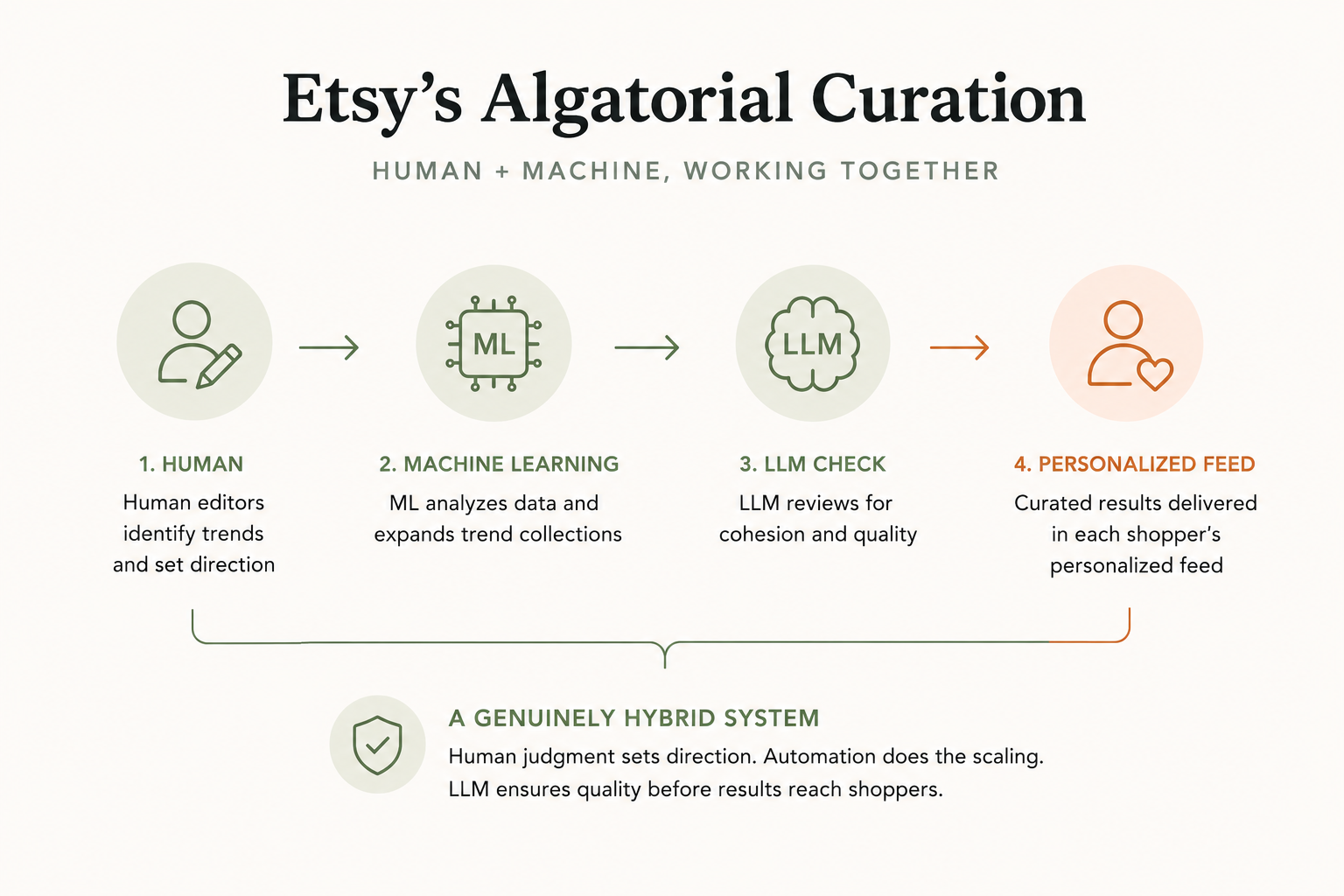
There's also "algotorial" curation at work: human editors seed trend collections, machine learning expands them, and an LLM checks the results for cohesion before they reach a shopper's personalized feed. It's a genuinely hybrid process — human judgment setting direction, automation doing the scaling.
Worth being careful about here: you'll see numbers floating around in industry press — figures like a roughly 5% lift in SEO-driven visits or a 3% conversion lift tied to AI, and mentions of a ChatGPT shopping integration in beta. None of that has been confirmed by Etsy itself, so this guide isn't presenting it as fact. Treat anything beyond the semantic relevance and attribute extraction numbers above as unverified until Etsy says otherwise.
Etsy SEO Myths, Debunked
You've likely absorbed a few of these without realizing where they came from. Here's the full list, side by side with what's actually true.
- Myth: Keyword-stuffed titles rank higher
Reality: The 2026 title guidance explicitly moves away from this — state the item once, keep it under ~15 words - Myth: Word order in your title affects ranking
Reality: It doesn't affect ranking. Front-loading helps human click-through on mobile, which is a different effect entirely - Myth: The description barely matters
Reality: The first few sentences are part of query matching — it's read the same way your title and tags are - Myth: Renewing listings farms a permanent ranking boost
Reality: Recency is a temporary signal, not something you can farm. One seller renewed weekly expecting a lasting boost and saw no permanent change — the effect faded each time - Myth: Searching for your own listing tells you your real rank
Reality: CSR personalization means results are tailored to you specifically, making self-searches unreliable. Use Shop Stats instead - Myth: Etsy Plus or Etsy Ads boost organic ranking
Reality: Neither affects organic ranking. Ads are paid placement; Plus is a tools subscription - Myth: Repeating a keyword in every field helps
Reality: Repetition only ever helps matching, and root-word/plural matching already covers most of that without repetition - Myth: Star Seller boosts your ranking
Reality: It's a trust badge built from service metrics, not an independent ranking factor - Myth: AI's role in Etsy search is speculative
Reality: It's confirmed and active today — semantic relevance and attribute extraction are both measured, published improvements
What Etsy Won't Tell You (and Why That's Fine)
Some questions genuinely don't have public answers, and it's worth naming them plainly instead of pretending otherwise:
Not Published:
- The exact ranking formula or the weight given to each factor
- A specific keyword-stuffing penalty threshold
- The internal mechanics of CSR personalization
- How long the recency boost actually lasts
- Confirmation or denial of every seller-forum theory in circulation
- AI-impact percentages beyond the two confirmed figures in this guide
- Google's own algorithm, which sits outside Etsy's control entirely
None of this means there's a secret playbook you're missing out on. It means the system is genuinely more art than exact science in places, even for the people who built it — and that's normal for any large search system. Your job isn't to reverse-engineer the missing 10%. It's to execute well on the 90% that is documented, which is exactly what this guide has walked through.
Your Repeatable Etsy SEO Checklist
Run through this on every new listing, and periodically on older ones. The notes in italics fold in the most common mistakes sellers make in each area.
Titles
- States the item once, as a noun
- Leads with the top three objective descriptors
- Under ~15 words
- No price, sale, or shipping language
- No repeated phrases
Tags
- All 13 slots filled with distinct multi-word phrases
- No duplicated phrases from category or attributes
- No intentional misspellings
- Note: don't neglect this field just because it feels mechanical — 13 unused or duplicated slots is 13 missed matching opportunities
Categories & Attributes
- Filed under the deepest available subcategory
- Every applicable attribute filled — none left blank out of laziness, none guessed just to fill space
Descriptions
- First few sentences written in natural language, not a keyword list
- Essential facts and bullets near the top
- Maker's story placed toward the end, not the beginning
Photos
- First photo at least 635px wide, ideally 2000px
- Horizontal or square, with negative space, in sRGB
- Real finished-product photo as primary for personalized items; mockups kept to additional photos only for POD
- Note: photography is the most commonly neglected field relative to its impact — don't let it be the one thing you never revisit
Customer Experience
- First-message response within 48 hours
- Case rate kept under 0.25%
- Shipping on time, with a clear return policy in place
- US shipping kept under $6 where feasible
General habits worth checking honestly
- Are you renewing listings hoping for a permanent boost? Stop — it's temporary and doesn't compound
- Are you searching for your own listing to check your rank? Use Shop Stats instead — CSR personalization makes self-searches unreliable
- Are you relying on Etsy search alone? Marketing outside Etsy (Shopify, TikTok Shop, Amazon, social) still matters for traffic Etsy's algorithm never touches
- Are you giving up after a few weeks? Listing quality is a rolling three-month signal — give changes time to actually show up
FAQ
Does editing an existing listing hurt my ranking?
No. Updating a title, tags, or photos to follow current guidance doesn't penalize you — it's a normal part of maintaining a listing well.
Does word order in my title matter for ranking?
Not for ranking. It matters for click-through on mobile, where longer titles get truncated, so front-loading your key terms still helps a shopper decide to click.
Should I renew my listings often to rank higher?
No. Recency is a temporary signal, not something that accumulates. Renewing on a schedule for ranking purposes doesn't produce a lasting boost.
Do I need to add plural versions of my tags?
No. Root words and plurals are matched automatically, so use that slot for a genuinely different phrase instead.
Does Etsy Plus or Etsy Ads help me rank higher organically?
No. Neither affects organic ranking — Ads is paid placement, and Plus is a shop-tools subscription.
Why can't I find my own listing when I search for it?
Search results are personalized to each shopper's history through CSR personalization, which makes your own search an unreliable way to check your ranking. Check Shop Stats instead.
Conclusion & Next Step
Etsy SEO isn't about finding better tricks.
It's about giving Etsy better information.
Every clear title helps Etsy understand what you're selling.
Every accurate tag gives Etsy another clue about who it's for.
Every relevant attribute makes it easier for the right buyer to find you.
Every helpful description builds confidence.
Every great photo earns another click.
Every satisfied customer strengthens your shop over time.
Individually, those improvements may seem small. Together, they create listings that are easier for Etsy to understand, easier for buyers to trust, and more likely to be discovered.
The good news is you don't have to memorize every best practice or spend hours researching keywords every time you create a new product.
That's exactly why we built ListSage.
ListSage handles the research, keyword discovery, platform-specific requirements, and listing optimization for you—turning your product information into ready-to-post listings for Etsy, Shopify, Amazon, TikTok Shop, and other marketplaces in minutes instead of hours.
That means less time researching, less time rewriting, and more time creating products, serving customers, and growing your business.
Whether you're publishing your first listing or your five hundredth, the goal stays the same: create listings that are clear, helpful, and easy for buyers to discover.
Master that process once, and every listing you create becomes a little stronger than the last.
.png)
Lindsey Records
Founder of ListSage and a content strategist with 15+ years of experience in SEO, ecommerce, and AI. After growing her own Etsy and Shopify stores, she built ListSage to eliminate the hours of research, prompting, and rewriting required to create high-performing product listings.