.png)
Choosing your first selling platform can feel like choosing the future of your business. Fortunately, it isn't. It's closer to choosing the right tool for the stage you're at right now — one you can absolutely change later.

Many new sellers ask, "Should I start on Etsy or Shopify?" It's a reasonable question, but it's not quite the right one. The better question is: "What kind of business am I trying to build?" Etsy and Shopify aren't competing answers to the same problem — they're built to solve two different problems entirely. Once you understand what each platform is actually designed to do, the "which one" question tends to answer itself, at least for where you are right now.
This guide isn't going to tell you that one platform is better than the other, because that isn't a coherent claim to make. A platform that's a great fit for a solo maker testing a handmade jewelry line might be a poor fit for a growing apparel brand trying to build a loyal, repeat-purchase customer base — and vice versa. What we can do is walk through the structural differences that actually matter, so you can match them against your own goals.
Underneath all of those differences, there are really only three questions worth asking about any selling platform:
The Three Questions
- Who brings the customers?
- Who owns the relationship?
- Who controls the experience?
Every chapter in this guide is really just one of these three questions, answered in more detail. Keep them in mind as a lens as you read, not a scorecard — there's no version of this guide where "2 out of 3" wins.
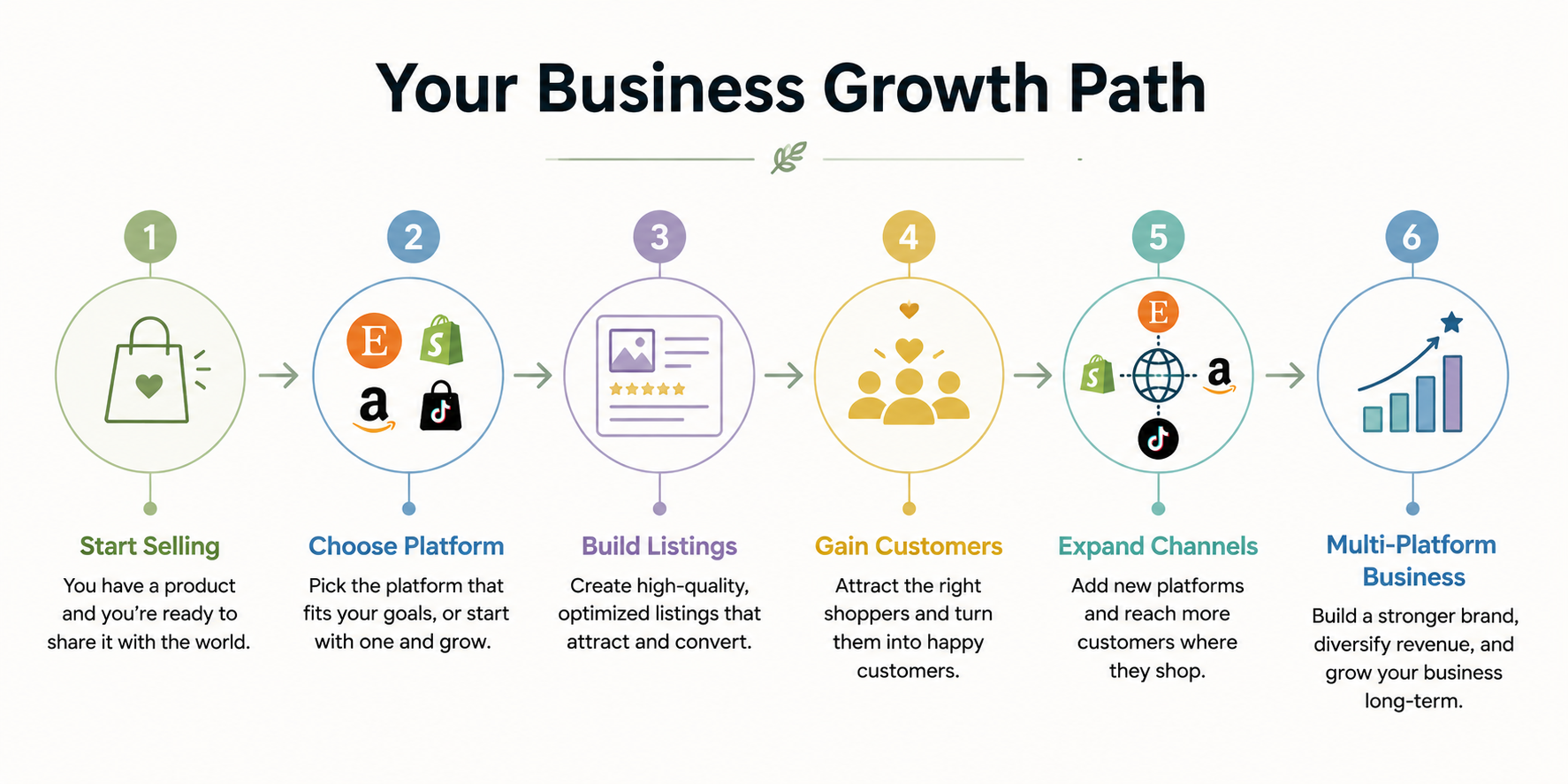
It also helps to see this as a stage rather than a permanent commitment. Most sellers move through something like this path over time: Start Selling → Choose Platform → Build Listings → Gain Customers → Expand Channels → Multi-Platform Business. Where you are on that path today doesn't lock you into a single choice forever. Sellers switch, add a second platform, or run both at once — we'll get into exactly how and why later in this guide.
What you'll learn:
- The Three Questions that determine which platform fits your goals: who brings the customers, who owns the relationship, and who controls the experience
- Why Etsy and Shopify are structurally different businesses, not just different-looking storefronts
- Who each platform's rules and design actually fit
- How the two platforms' costs are shaped differently, not just priced differently
- Where your traffic and buyers actually come from on each platform
- Who owns the customer relationship after a sale
- How each platform handles growth, scale, and selling on both at once
- Common seller scenarios and the tradeoffs tied to each one
- A self-assessment checklist to help you make your own call
Chapter 1: The Core Divide — Marketplace vs. Your Own Storefront
If you take only one idea away from this guide, make it this one: almost every other difference between Etsy and Shopify traces back to a single structural fact. Etsy is a marketplace. Shopify is not.
Think of it this way. Selling on Etsy is like renting a booth in a busy market. The foot traffic is already there — shoppers are walking past, browsing, and comparing booths, often before they've ever heard of your specific shop. That's valuable. But you're renting space inside someone else's market, which means you follow the market's rules, and it's the market's brand — Etsy — that shoppers trust and remember first, not necessarily your shop's name.
Selling on Shopify is like opening your own store on a quiet street. You have total control over what the storefront looks like, how it's laid out, what it says, and how checkout works. Nobody else's rules govern your shop's design or policies. But there's a tradeoff baked into that freedom: you're also entirely responsible for getting anyone to walk down that street in the first place. No one is passing by unless you brought them there.
This isn't an arbitrary policy choice — both companies describe themselves this way. Etsy calls itself a two-sided marketplace connecting buyers and sellers, built around a shared matching layer: search, browsing, and trust signals between strangers. Shopify describes itself as software for building an independent store, explicitly "not a marketplace" — it hands you the tools, not the buyers.

Every chapter that follows — fees, discoverability, branding, growth — is really just this same distinction showing up in a different context. Etsy's fee structure exists because Etsy is providing shared infrastructure and an audience. Shopify's fee structure exists because it's licensing you software and letting you operate independently on it. Etsy's search algorithm exists because it's mediating between many sellers and one shopper. Shopify has no comparable internal search to compete in, because there's no shared marketplace to search within.
Keep this "rented booth vs. your own building" idea in your head as you read the rest of this guide. It will make each subsequent chapter feel less like a random list of feature differences and more like the logical consequence of one foundational choice.
It's worth sitting with this distinction a little longer, because it's easy to underestimate how far it reaches. On Etsy, when you write a product title or description, you're partly writing for a human shopper and partly writing for Etsy's internal search system, because that system is the primary way strangers ever see your listing at all. On Shopify, your product page doesn't need to satisfy an internal marketplace algorithm — but it does need to hold up as a standalone destination, because whoever lands on it got there through effort you generated, whether that's an ad you paid for, a search result you earned, or a social post you wrote yourself. Neither approach is more or less "real" marketing; they're simply marketing aimed at two different gatekeepers — Etsy's internal ranking system on one side, and the open internet on the other.
This also explains why comparing Etsy and Shopify feature-by-feature can be misleading if you don't first anchor it to this structural difference. It's tempting to make a list of "Etsy has X, Shopify has Y" and treat every row as equally weighted, the way you might compare two versions of the same kind of product. But Etsy and Shopify aren't two versions of the same kind of product — one is a marketplace you rent space in, and the other is software you use to build something that's entirely yours. Once that's clear, differences in fees, search visibility, and branding control stop looking like a random grab-bag of pros and cons and start looking like the predictable downstream effects of one upstream decision: whether you're operating inside someone else's marketplace or building your own storefront from the ground up.
🦉 Sage Tip: If you're not sure which model fits, ask yourself: "Do I want a system to introduce me to buyers, or do I want to own the entire environment my buyers experience?" There's no wrong answer — just a different starting point depending on what you already have (an audience, a product category, marketing skills, time) and what you're missing.
This chapter has really been answering the third of the Three Questions — who controls the experience. On Etsy, Etsy controls the shared marketplace experience; on Shopify, you do. If you want a quick, gut-level starting point before reading further, try this:
- Need customers immediately? Etsy is worth trying first.
- No, but you already have an audience? Shopify is worth trying first.
- Neither yet? Keep reading — the next few chapters will help you figure out which one fits.

Chapter 2: Who Each Platform Tends to Fit
Before the policy details, it's worth asking a more personal question: which of these sounds more like you?
Ideal Etsy seller: "I love making products." You're energized by the craft itself — the making, the sourcing, the curating — and you'd rather a platform hand you an audience than spend your time building one from scratch.
Ideal Shopify seller: "I want to build a brand." You're thinking beyond any single product — about a name, a look, a customer base you'll recognize by their second or third order — and you're willing to do the work of finding buyers yourself in exchange for owning that experience end to end.
Neither instinct is right or wrong, and plenty of sellers feel some pull toward both. But that gut reaction is a genuinely useful starting point, because Etsy's rules and Shopify's design both quietly assume one of these two mindsets.
Etsy's rules reflect the "I love making products" seller directly: listings are generally restricted to handmade or hand-altered items, hand-assembled goods, vintage items at least 20 years old, craft and party supplies, and digital goods (including disclosed AI-assisted digital creations). Since 2024, Etsy also permits disclosed production-partner or print-on-demand (POD) use for physical goods — disclosed on the listing and in the shop's About section — though not for vintage or supply categories.
Shopify's lack of any category restriction reflects the "I want to build a brand" seller: it's general-purpose commerce software built to sell any product type, used by everyone from solo sellers to large multi-location brands. Shopify isn't gatekeeping what you sell — it's handing you the infrastructure and leaving category fit up to you.
Quick Comparison: Category Rules
- Etsy: Handmade/hand-altered items, hand-assembled goods, vintage (20+ years), craft and party supplies, and digital goods — including disclosed AI-assisted digital creations. Production-partner/POD use for physical goods is allowed only with disclosure, and is not permitted for vintage or supply categories.
Shopify: No product-category restriction. General-purpose commerce software suitable for any product type, from solo sellers to large enterprise brands.
The practical takeaway: if what you sell doesn't fit Etsy's allowed categories, the "which platform" question is already answered for you in that direction. If it does fit, the decision moves on to the other factors in this guide — cost shape, traffic source, and how much control you want over the customer relationship.
Chapter 3: Costs and Fees — Two Different Shapes of Spending
One of the most common questions sellers ask is simply, "which one is cheaper?" It's an understandable question, but it's the wrong frame, because Etsy and Shopify don't just charge different amounts — they charge in fundamentally different shapes.
Etsy's fees function like a farmer's-market table fee plus a small cut of each sale: a relatively low-commitment cost that scales up or down with what you actually sell. If you sell nothing this month, you owe very little. If you sell a lot, your costs rise roughly in proportion.
Shopify's core plan cost functions more like signing a monthly lease: a fixed cost that comes due whether one customer walked through the door or a hundred did. That fixed cost buys you the software and infrastructure to run your own store regardless of sales volume.
Quick Comparison: Fee Categories (not amounts)
- Etsy fee categories: A per-listing fee, a percentage-based transaction fee on sales, a payment-processing fee, an offsite-ads fee that applies only when a sale is attributed to an ad Etsy placed externally on your behalf, and optional paid subscription tiers (such as Etsy's Plus or Pattern offerings) for sellers who want additional tools.
Shopify fee categories: A tiered monthly subscription fee, a payment-processing fee, an additional third-party transaction fee that applies only if you use a payment processor other than Shopify's own, and optional costs for apps, premium themes, a custom domain, and any external advertising you choose to run.
Notice that neither list includes a single number. That's intentional: fees and pricing tiers on both platforms change over time, and any specific figure printed in a guide like this one would likely be outdated before long. For current numbers, always check Etsy's official Fees & Payments Policy and Shopify's official Pricing page directly — treat those as the source of truth, not any third-party summary, including this one.
So which is actually cheaper? Reframed honestly, that question is unanswerable in the abstract. It depends heavily on your sales volume and your appetite for risk. A seller making a handful of sales a month may find Etsy's usage-based model less financially risky, since costs stay low when sales are low. A seller confident in steady, higher-volume sales might find that a fixed monthly cost works out more favorably per sale, and comes with fewer moving fee categories to track. Neither answer is universally correct — it depends on your goals, your product's price point, and how predictable your sales volume already is.
🦉 Sage Tip: Before comparing costs, model your own numbers using both platforms' current, official fee pages and your realistic expected sales volume — not an average or a best-case guess. The "cheaper" platform is specific to your situation, not a fixed ranking.
Chapter 4: Getting Found — Traffic, Search & Discoverability
This chapter follows directly from Chapter 1's core divide, applied to the question of how buyers actually find your products — the first of the Three Questions from the introduction: who brings the customers?
Etsy functions like a mall with existing walk-in shoppers already browsing multiple stores. Someone searching Etsy for "ceramic mug" may land on your shop without ever having heard of it before, because Etsy's internal search and recommendation engine is actively surfacing listings to shoppers who are already there and already in a buying mindset. Etsy controls that ranking system, and it's constantly matching shopper intent to seller inventory across the entire marketplace.
Shopify is more like a storefront on a private road. There's no internal marketplace search to compete in, because there's no shared marketplace — your store exists on its own domain, discovered the same way any independent website is discovered. That means driving traffic falls entirely on external channels: Google search, social platforms, paid advertising, and email marketing. It's worth noting that Shopify's own SEO guidance is explicitly about helping merchants rank in Google search results, not about an internal discovery layer the way Etsy's search functions — because no such internal layer exists on Shopify.
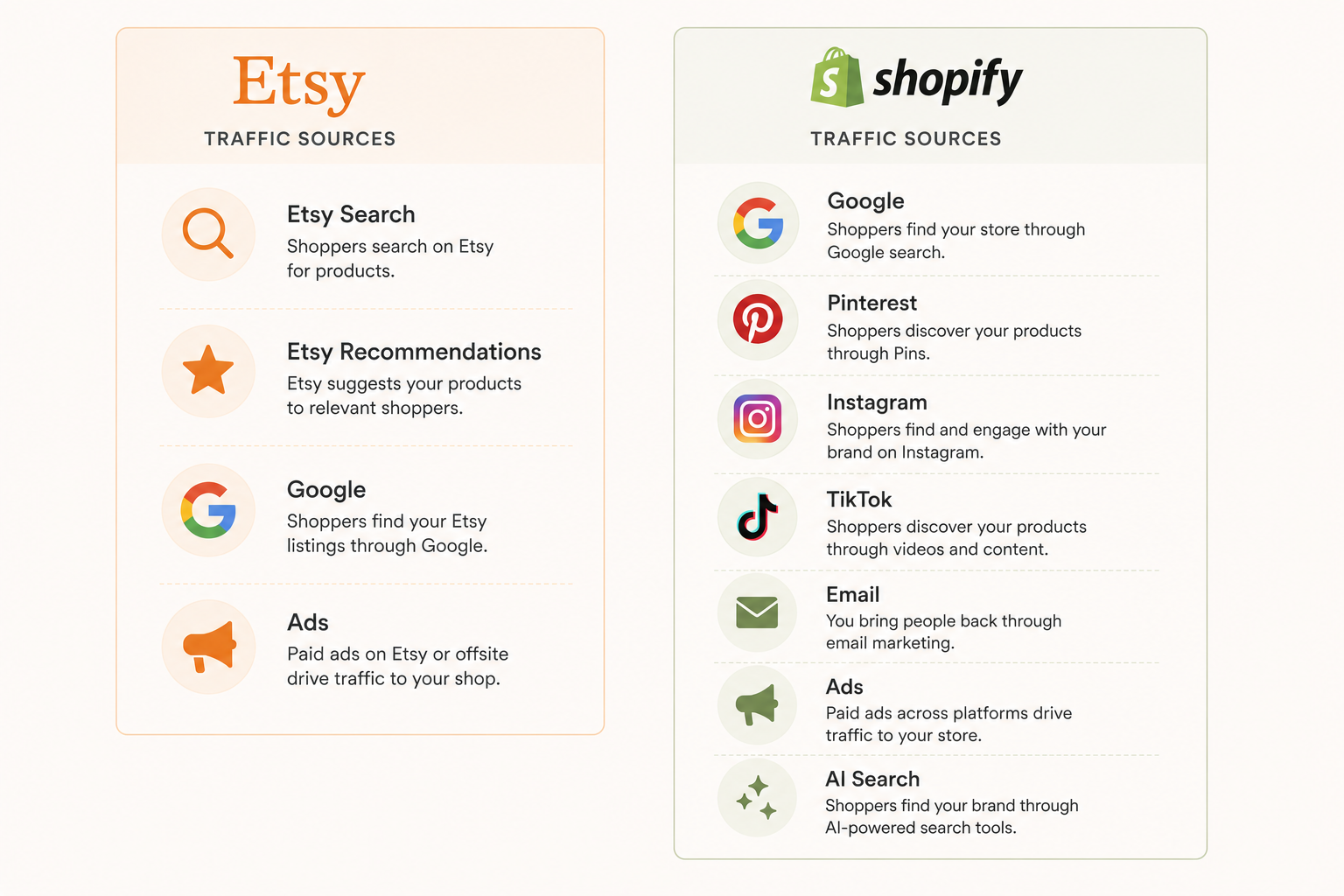
Marketplace Note: A well-optimized Etsy listing can still get outside traffic from Google, and Etsy sellers can run their own paid ads too — Etsy isn't the seller's only source of traffic, just the built-in one. Likewise, a Shopify store isn't limited to paid channels; organic search, social content, and word of mouth all count as "external" traffic the merchant has to build, but they don't all require an ad budget.
It's also worth briefly addressing a fast-moving area: AI-driven shopping discovery. Shopify has officially documented tools in this space, including Shopify Catalog, a Storefront MCP, and involvement in a broader Universal Commerce Protocol aimed at helping AI shopping agents interact with merchant storefronts. Separately, according to OpenAI's own merchant documentation, sellers on both Etsy and Shopify are automatically eligible for catalog integration with ChatGPT's shopping features. This is genuinely useful context, but it's worth being direct about the uncertainty here: this entire space is evolving quickly, official capabilities and eligibility criteria are likely to keep changing, and no guide — including this one — can responsibly promise any specific ranking, visibility, or sales outcome from AI-driven discovery on either platform. Treat it as an emerging factor to keep an eye on, not a deciding one today.
Quick Comparison: Discoverability Model
- Etsy: Built-in shopper base with an internal search and recommendation engine that Etsy controls; supplemented by external channels sellers choose to add on their own.
Shopify: No internal marketplace search; discoverability depends entirely on external channels the merchant builds and maintains — organic search, social platforms, email, and paid advertising.
Chapter 5: Branding and Who Owns the Customer Relationship
This chapter answers the second of the Three Questions: who owns the relationship? It's one of the most consequential differences for sellers thinking beyond their first sale, and it again traces back to the marketplace-vs-storefront divide.
Selling on Etsy is a bit like being a market vendor who isn't allowed to take shoppers' contact information for your own future promotions — the market operator keeps that relationship, because it's the market's job to keep shoppers coming back to the market as a whole, not to any single vendor. Selling on Shopify is like handing every customer your own business card and building your own mailing list — that list belongs to you and leaves the market with you, because there is no shared market to begin with.
Concretely: Etsy sellers can customize their shop's appearance within Etsy's marketplace template — banner images, a shop logo, an About section, and featured items — but this customization happens inside Etsy's overall marketplace framework, and deeper customization options are gated behind optional paid tools like Etsy Plus. More importantly, Etsy's Seller Policy restricts using buyer data for a seller's own external marketing purposes and prohibits redirecting buyers off-platform before a purchase is completed. In other words, even highly engaged Etsy buyers generally can't be added to a seller's own independent email list the way a direct-to-consumer brand would build one.
Shopify sellers have full control over their site design, branding, and checkout experience, and — critically — the merchant owns 100% of their customer data. That means Shopify merchants can build direct email and SMS marketing relationships with their customers without the kind of marketplace data-use restrictions that apply on Etsy.

Common Mistake: Assuming that Etsy sales automatically build a reusable customer list or email audience the way a Shopify store naturally does. They don't — and this trips up a lot of sellers who plan to eventually "graduate" to their own list. Etsy's data-use restrictions mean that a customer who bought from you five times on Etsy hasn't handed you their email address the way a Shopify customer typically does at checkout. If building a direct, repeat-purchase relationship with your own audience is a long-term goal, that's a meaningful structural limitation to plan around now, not later.
Once again, this isn't a case of one model being objectively better — it depends on your goals. A seller who values low-commitment testing and doesn't currently need a proprietary customer list may not mind this tradeoff at all. A seller building a brand meant to have long-term, repeat, direct-relationship customers will likely find this restriction more significant.
Chapter 6: Growth, Scale, and Selling on Both
As a shop grows, the platforms diverge further in how they support scale.
On Etsy, sellers who want more standalone-website capability can opt into Pattern by Etsy, a paid add-on that lets a seller build a simple linked website outside the core marketplace listing pages. There's no explicit, officially stated cap on how large an Etsy shop's catalog can grow, though individual listings expire periodically and need to be renewed to stay active. Etsy also doesn't offer native wholesale or business-to-business (B2B) tooling comparable to what Shopify provides.
Shopify officially supports unlimited products on every plan tier. Wholesale and B2B catalog capabilities, along with multi-location support, scale up with the plan tier a merchant is on, and an enterprise-level plan tier exists for larger operations. Shopify also natively supports multi-channel selling, meaning a single Shopify backend can connect to and sync with several different sales channels at once.
This brings up a question a lot of sellers eventually ask: can I just run both? The honest answer involves a bit of an asymmetry worth stating plainly.
Quick Comparison: Running Both Platforms
- Shopify's stance: Shopify officially documents and supports running an Etsy shop and a Shopify store at the same time. Apps like Marketplace Connect are built specifically to sync inventory and orders between Etsy and Shopify, and Shopify frames running both as a legitimate, supported strategy — not an either/or decision.
Etsy's stance: Etsy's Seller Policy contains no exclusivity clause prohibiting sellers from also running a Shopify store. However, Etsy doesn't build tooling for that combination or actively promote it the way Shopify does. Etsy's silence on the matter should be read as "not prohibited," not as active endorsement or support of running both.
In practice, plenty of sellers do use both: Etsy as a discovery and testing channel, Shopify as the owned, brand-building home base — with the growth path from the introduction (Start Selling → Choose Platform → Build Listings → Gain Customers → Expand Channels → Multi-Platform Business) landing exactly here for many businesses. Whether that combination makes sense for you depends on your product, your capacity to manage two systems, and how much you value each platform's respective strengths.
Marketplace Note: Running two platforms also means running two sets of operational habits — separate listing formats, separate fee structures to track, and (unless you're using a syncing app) separate inventory counts to keep updated. None of that is a reason to avoid combining platforms, but it is a real cost worth planning for, distinct from the fee categories covered in Chapter 3.
Chapter 7: Decision Scenarios — Which Situation Sounds Like You?
Rather than issuing a verdict, this chapter walks through common situations sellers find themselves in, and connects each one back to the concepts covered above. None of these are meant to box you into a permanent identity — they're starting points.
1. "I make handmade jewelry or craft items."
Handmade goods sit squarely within Etsy's allowed categories (Chapter 2), and this scenario also connects to the traffic discussion in Chapter 4: shoppers actively browsing a marketplace for handmade goods are a natural fit for products in this category. The tradeoff is the same one from Chapter 5 — built-in browsing traffic, in exchange for less control over the customer relationship and no proprietary email list from those sales.
2. "I sell digital downloads."
Digital goods are Etsy-eligible (Chapter 2), and this scenario ties closely to the usage-based fee structure from Chapter 3: because digital products often have minimal production cost, a fee structure that scales with actual sales can make low-friction testing more approachable than committing to a fixed monthly cost before you know whether the product sells at all.
3. "I run a print-on-demand brand."
This one requires an explicit note: Etsy permits disclosed production-partner/POD use for eligible physical-goods categories, but the disclosure must appear both on the listing and in the shop's About section (Chapter 2) — it's not optional. Shopify carries no equivalent restriction. This scenario also surfaces real tension with Chapter 5's customer-ownership discussion: POD brands are often trying to build a recognizable brand identity over time, which is harder to do within Etsy's shared marketplace template and data-use restrictions than on an independently branded Shopify store.
4. "I already have an audience (social following, email list)."
This flips the traffic tradeoff from Chapter 4. Shopify's biggest structural downside — that you have to generate all your own traffic — matters considerably less if you can already reliably reach an existing audience. In this scenario, the branding and customer-ownership advantages from Chapter 5 may weigh more heavily, since you're not starting from zero on the traffic side.
5. "I'm testing an idea with no following yet."
Here, Etsy's built-in shopper base (Chapter 4) can lower the cost of simply finding out whether a product sells at all, without first needing to build an audience or a marketing engine from scratch. This connects back to Chapter 3's usage-based fee shape as well — testing with lower fixed commitment can reduce the downside of an idea that doesn't pan out.
6. "I've outgrown Etsy and want more control, margin, or brand loyalty."
This scenario connects most directly to Chapters 5 and 6: wanting to own the customer relationship, build a repeat-purchase list, and access wholesale or multi-location tooling as the business scales. It's also where the "selling on both" and migration discussion from Chapter 6 becomes most relevant — many sellers in this position don't abandon Etsy outright, but add or shift toward Shopify as the brand-owned home base.
These six scenarios are starting points, not fixed identities. Sellers regularly move between them as a business changes — someone who starts in scenario 5 may find themselves in scenario 6 a year later, and that's a normal part of the growth path, not a sign anything went wrong with the original choice.
It's also common for a single seller to recognize themselves in more than one scenario at once — a print-on-demand seller (scenario 3) who also already has a modest social following (scenario 4), for example. When that happens, treat the scenarios as separate lenses on the same decision rather than competing categories you have to pick one of. Read back through the concepts each scenario points to, weigh which tradeoffs matter most for your specific situation, and let that guide your next step — not which single scenario label fits "best."
Chapter 8: Your Decision Checklist
Rather than generating a verdict, use these questions as a self-assessment. There's no scoring system — the goal is to surface what actually matters to you right now.
- Do you want built-in traffic from day one, or full control over your brand's storefront?
- Do you enjoy marketing and generating your own traffic, or would you rather not have to build that from scratch?
- Do you need to test a product idea cheaply before committing to a fixed monthly cost?
- Do you want to own your customer list so you can build repeat business directly?
- Could wholesale, B2B, or multi-channel growth matter to your business eventually?
- Would running both platforms eventually make sense for your goals, rather than choosing just one?
If you'd rather see it at a glance, here's a simple decision matrix pulling together the scenarios and tradeoffs covered so far. Like everything else in this guide, treat it as a starting point, not a verdict — it's a fast way to check your gut answer against the reasoning above, not a replacement for it.
Decision Matrix
- If you want buyers immediately: Etsy
- If you already have an audience: Shopify
- If you sell handmade goods: Etsy
- If you want full branding control: Shopify
- If you want to own an email list: Shopify
- If you want to test a product idea cheaply: Etsy
Quick Comparison: The 5 Core Concepts at a Glance
- Structure: Etsy is a shared marketplace connecting buyers and sellers; Shopify is independent commerce software for your own store.
- Fit: Etsy restricts listings to specific categories (handmade, vintage, craft supplies, digital goods, disclosed POD); Shopify has no product-category restriction.
- Cost shape: Etsy's fees scale with what you sell; Shopify's core cost is a fixed subscription regardless of sales volume.
- Discoverability: Etsy provides an internal search and recommendation engine; Shopify relies entirely on external channels you build yourself.
- Customer ownership: Etsy restricts using buyer data for your own marketing; Shopify gives you full ownership of customer data and direct-marketing ability.
Frequently Asked Questions
Can I sell on both Etsy and Shopify?
Yes. Shopify officially supports and documents running both at once, including apps like Marketplace Connect that sync inventory and orders between the two.
Do I need an LLC to start?
Not necessarily to open a shop on either platform, though your business structure affects taxes, liability, and payment processing eligibility — consult a qualified professional for guidance specific to your situation and location.
Which platform costs less?
It depends on your sales volume and situation, not a fixed number — Etsy's usage-based fees and Shopify's fixed subscription cost behave very differently depending on how much and how consistently you sell.
Can I move from Etsy to Shopify later?
Yes, many sellers do this as they grow, often after starting on Etsy to test demand and later moving toward Shopify for more brand and customer-relationship control.
Can Shopify bring its own traffic?
No — Shopify relies entirely on external channels like Google, social platforms, email, and paid ads. There's no internal marketplace search built into Shopify the way there is on Etsy.
Can I connect Etsy and Shopify?
Yes, via third-party apps such as Marketplace Connect, which sync inventory and orders between an Etsy shop and a Shopify store.
Conclusion
There isn't one correct answer to "Etsy or Shopify." Both platforms are well-built for what they're actually designed to do — Etsy for shared-marketplace discovery within specific product categories, Shopify for independent, fully brand-controlled commerce. The right choice is the one that matches your current stage: what you're selling, how much traffic you can generate on your own, how much you value owning the customer relationship, and how much fixed cost you're comfortable carrying before you know your sales volume.
If you've read this far and still want something more concrete than "it depends," here's the closest thing to a straight answer this guide can honestly give:
Start on Etsy if: you're testing an idea, you don't have an audience yet, or you want built-in shoppers from day one.
Start on Shopify if: you already have customers or an audience, you're building a brand, or you want full ownership of the customer relationship.
Use both if: you're growing past your first stage, and you want Etsy's discovery alongside Shopify's branding — this is where the Three Questions from the introduction tend to point most sellers eventually.
It's also worth remembering that many successful sellers don't pick one and stop there — they eventually use both, often starting on one and adding the other as their business grows and their goals shift.
One thing doesn't change no matter which platform you choose: every marketplace expects listings to be written differently. Whether you're selling on Etsy, Shopify, or both, every product still needs a high-quality listing — and it's often the part of the process that eats the most time, research, writing, formatting, and tailoring the same product description for different marketplace requirements. That's where ListSage becomes relevant: it creates ready-to-post listings tailored for each marketplace from a single product description, saving hours of research, rewriting, and formatting, so you can spend more time on the parts of your business only you can do.
.png)
Lindsey Records
Founder of ListSage and a content strategist with 15+ years of experience in SEO, ecommerce, and AI. After growing her own Etsy and Shopify stores, she built ListSage to eliminate the hours of research, prompting, and rewriting required to create high-performing product listings.